 Colorado Criminal Lawyer Blog
Second Look Sentencing Will a Colorado Judge Reconsider My Sentence? Crim. P. 35(b)


By H. Michael Steinberg, A Colorado Criminal Defense Lawyer – Practicing Colorado Criminal Law in the courts of Colorado for over 40 years.
Introduction:
A sentence feels final the moment a judge announces it. In Colorado, it is not always. Colorado Rule of Criminal Procedure 35(b) gives the sentencing judge a narrow window to take a second look and reduce a sentence they have already imposed.
And in 2026, Colorado added a brand-new second look process for certain long-serving prisoners. Both tools are real but limited, and the deadlines are unforgiving.
What Is a Rule 35(b) Motion?
A Rule 35(b) motion, often called a “motion for reconsideration of sentence” or a “35(b),” asks the same judge who sentenced you to reduce a lawful sentence. It is not an appeal. You are not arguing that the judge made a legal mistake. You are asking the judge to use their discretion again, with fresh information and the benefit of time.
The rule itself is short. It says the court may reduce the sentence if a motion is filed within the deadlines set by the rule. It also allows the court to deny the motion without a hearing after considering the motion and any supporting documents, and to reduce a sentence on its own initiative within the same time periods. Colorado courts describe the purpose of the rule as temporarily suspending the finality of the original sentence to allow the judge to reconsider it.
Rule 35(b) can apply to any part of a sentence: prison, jail, probation, community corrections, fines, and treatment conditions. Judges are under no obligation to grant relief when the original sentence was lawful, so the motion works best when it gives the judge a genuine reason to see the case differently.
The 126-Day Deadline: Count Carefully
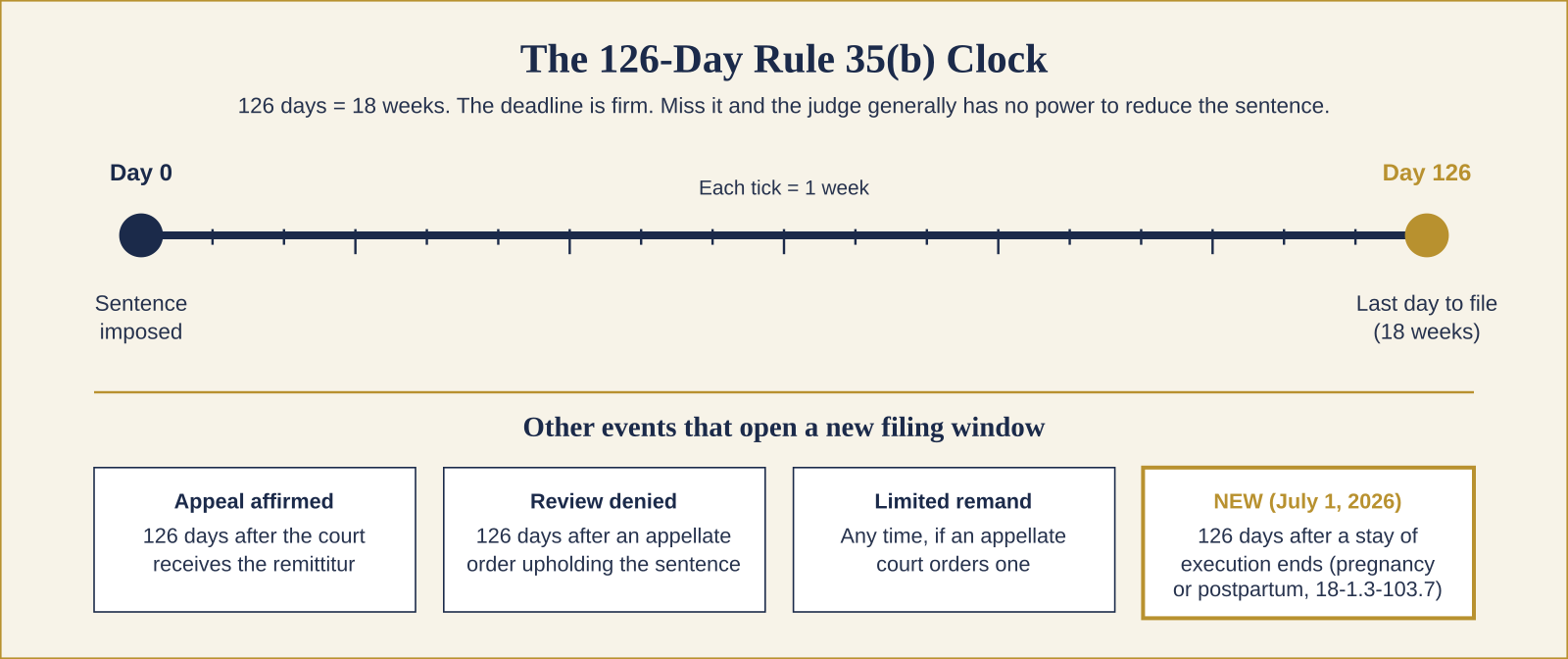
Colorado extended the old 120-day period to 126 days (18 weeks), and the Colorado Supreme Court has recognized the longer period in recent decisions. If you do not appeal, the clock starts on the day the sentence is imposed.
Rule 35(b) also opens a new 126-day window in several other situations.
- No appeal: within 126 days after the sentence is imposed.
- Appeal affirmed or dismissed: within 126 days after the trial court receives the remittitur.
- Appellate review denied: within 126 days after an appellate order or judgment denying review or having the effect of upholding the conviction or sentence.
- Limited remand: at any time, if an appellate court orders a limited remand during a direct appeal.
- Stay of execution (new): within 126 days after a stay of execution ends, when the stay was granted to a pregnant or postpartum defendant under C.R.S. 18-1.3-103.7.
Heads up on a recent change.
The Colorado Supreme Court adopted an amendment to Rule 35 on June 25, 2026, effective July 1, 2026 (Rule Change 2026(13)). It added the stay-of-execution trigger above. Older articles and forms, including some that still say 120 days, may be out of date.
Because the deadline is tied to firm dates, do not assume you have extra time. If you are close to day 126, treat it as an emergency. Filing a simple, timely motion and supplementing it later is far safer than filing a polished motion too late.
How the Process Works
Can the Judge Make My Sentence Worse?
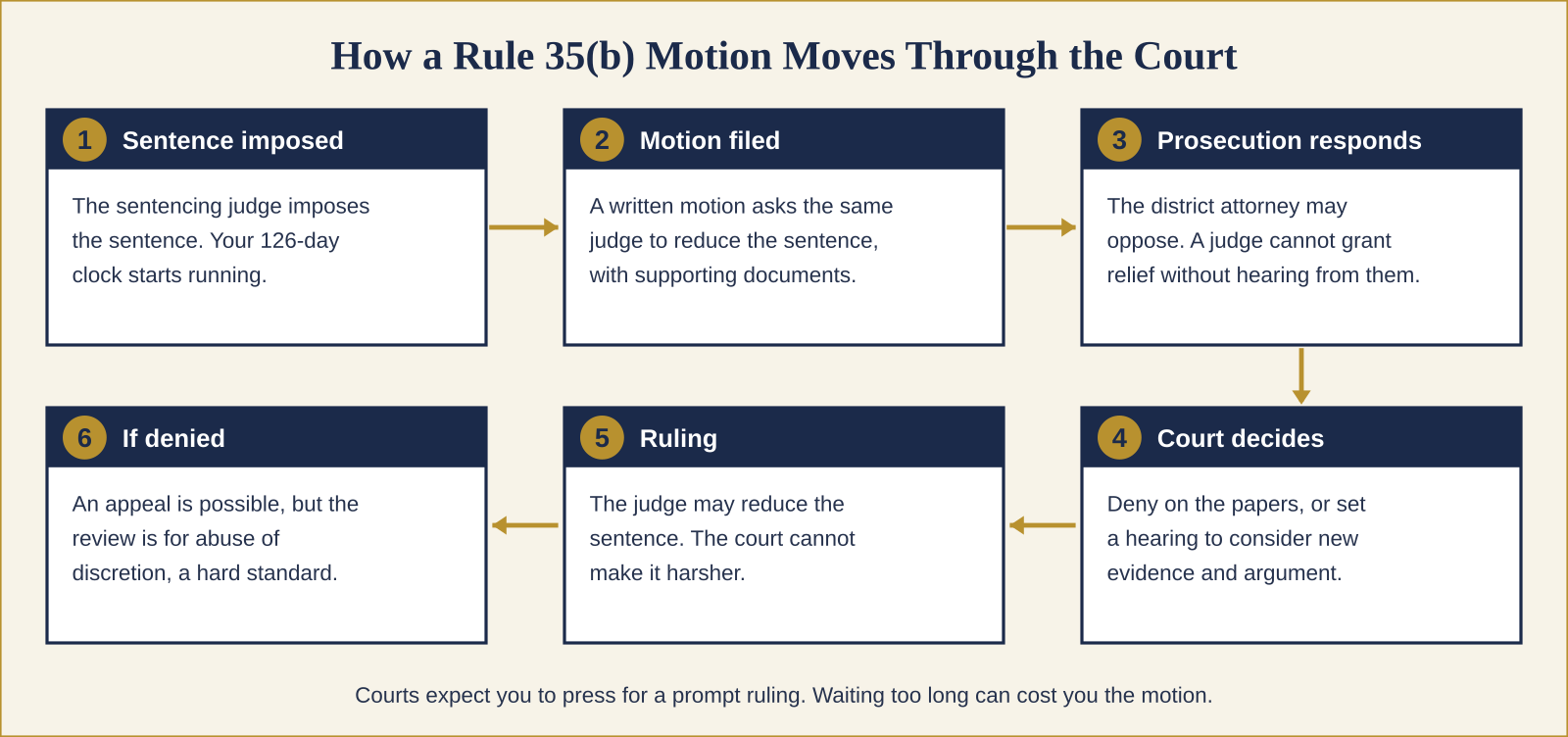
No. A Rule 35(b) motion is one of the few post-sentencing requests with essentially no downside on the sentence itself. The judge may reduce the sentence or leave it alone. Increasing it is not an option under this rule. That said, every hearing carries strategy risks, such as what you say on the record and what the prosecution presents in response, so the motion should be handled with care.
What Actually Persuades a Judge
Judges are asked to decide whether the sentence still serves the purposes of Colorado’s sentencing code, found in C.R.S. 18-1-102.5. Those purposes include punishment proportionate to the offense, consistency, deterrence, rehabilitation, tailoring the sentence to the individual to reduce re-offending, and accountability and restoration for victims and the community. A strong motion connects the request to those purposes.
- New mitigating information the judge did not have at sentencing, and a good explanation for why it was not available then.
- Treatment and program progress, such as completed substance use or mental health treatment, with documentation from providers.
- Acceptance of responsibility that is credible and specific rather than generic.
- Restitution and obligations paid or on a documented plan.
- Stability evidence: employment, housing, education, family responsibilities, and community support letters.
- Collateral consequences such as immigration, licensing, or the effect on dependents, where they are legitimately relevant.
- Institutional record, if the person is already in custody, as one part of the picture.
A Warning About “Good Behavior in Prison”
Colorado appellate courts have cautioned against using Rule 35(b) as a way to wait and build a prison record. In Mamula v. People, 847 P.2d 1135 (Colo. 1993), the Colorado Supreme Court held that a roughly twenty-month delay used to build a favorable Department of Corrections record was unreasonable, and the motion was treated as abandoned. Conduct in custody is relevant evidence, but courts have said it should not be the only reason for a reduction. The strongest motions tell the whole story of the person, not only a stack of certificates.
Do Not Let Your Motion Be “Abandoned”
Filing on time is only the first requirement. In People v. Fuqua, 764 P.2d 56 (Colo. 1988), the Colorado Supreme Court explained that a sentencing court keeps the power to rule on a timely motion for a reasonable period, but the motion can be treated as abandoned when the court fails to act within a reasonable time, and the defendant fails to make reasonable efforts to obtain a ruling. In practical terms: file, then follow up. Ask the court to set the motion for a hearing or ruling promptly, and keep a record of those requests.
Rule 35(b) vs. Rule 35(a) vs. Rule 35(c)
People often lump all post-sentencing motions together, but Colorado’s Rule 35 contains different tools for different problems.
| Rule | What it is for | Time limit |
|---|---|---|
| 35(a) illegal sentence | A sentence not authorized by law or imposed without jurisdiction | Any time |
| 35(a) illegal manner | A sentence imposed in an illegal manner | Same window as 35(b), generally 126 days |
| 35(b) | A request for leniency on a lawful sentence | 126 days, with restart triggers |
| 35(c) | Constitutional or other post-conviction challenges, such as ineffective assistance of counsel | Varies by offense level; felonies generally three years |
The Colorado Supreme Court’s 2025 decisions in Snow v. People and Tennyson v. People (2025 CO 31) show how much the label matters. Whether a restitution problem is an “illegal sentence” claim that can be raised at any time or an “illegal manner” claim subject to the short deadline can decide the entire case. If you suspect your sentence is not just harsh but legally flawed, a lawyer should review it quickly.
New in 2026: Colorado’s Second Look Law (SB 26-115)
The phrase “second look sentencing” usually refers to a different idea: letting people who have served decades in prison ask a court to reconsider their sentence based on who they are today. Colorado lawmakers considered such a bill in 2026, and the final version, Senate Bill 26-115, was signed into law on June 3, 2026. It creates a new statute, C.R.S. 18-1.3-411.
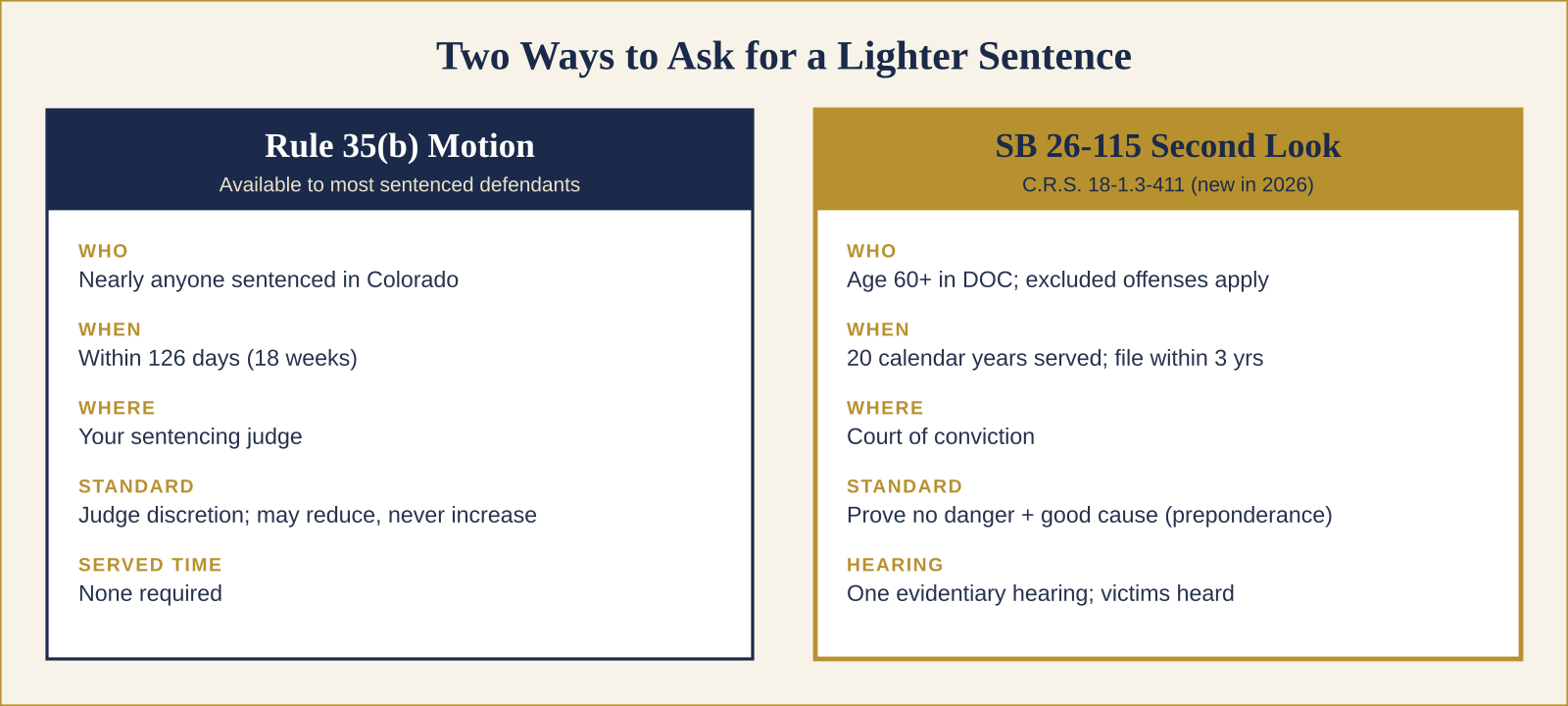
The bill changed along the way. As introduced, it also covered people whose offenses occurred before age 21. The sponsor’s amendment removed that group, so the enacted law applies only to people who are 60 years old or older at the time of filing and who have served at least 20 calendar years incarcerated for the offense.
What Is Excluded
A person is not eligible if they are in Department of Corrections custody because of a conviction for a sex offense described in C.R.S. 16-11.7-102(3), human trafficking for involuntary or sexual servitude, an offense that resulted in life without parole, an offense where the victim was a child under twelve, or an offense against a peace officer, emergency medical provider, or firefighter engaged in their duties. A district attorney may separately petition for relief for someone who is not eligible.
How the New Process Works
- Filing window: petitions may be filed on or before three years after the section’s effective date.
- Right to counsel: the petitioner has a right to counsel for all proceedings. In a pro se petition, the court appoints the Office of the State Public Defender or, if there is a conflict, Alternate Defense Counsel.
- One hearing: a person is entitled to only one evidentiary hearing on the merits and cannot file again afterward.
- Victims are heard: the district attorney must notify victims, and the court must give them an opportunity to be heard.
- Burden: the petitioner must show by a preponderance of the evidence that they no longer present a danger to the safety of any person or the community and that there is good cause to modify the sentence. The court may accept a stipulation from the parties.
- Factors: the court considers age at the offense and at the hearing, the nature of the offense and role, personal history including trauma, institutional compliance (particularly in the prior five years), programming, demonstrated rehabilitation, victim evidence, a health professional’s examination, and compliance with protection orders.
- The result: if the burden is met, the petitioner may file a Rule 35(b) motion that is not subject to the usual 35(b) time limits. The court then imposes an appropriate sentence, which must total at least 25 years but no longer than originally imposed, including up to five years of parole, or an alternative sentence permitted by law, or a sentence stipulated to by the parties.
Notice how the two tools interact. The second look statute does not replace Rule 35(b). It borrows it: after a successful petition, the Rule 35(b) motion becomes the vehicle for the actual resentencing, without the 126-day limit.
Which Option Fits Your Situation?
- Recently sentenced and within 126 days? Rule 35(b) is likely your best tool. Time is the critical factor.
- Appealed and lost? A new 126-day window may open after the remittitur or the appellate order. Watch the dates.
- Past 126 days, not on appeal, and the sentence seems legally wrong? Rule 35(a) or 35(c) may apply. Get a legal review immediately.
- Age 60 or older with 20 or more years served in prison? The new second look statute may apply, subject to the exclusions above.
- Neither fits? Other routes, such as parole, earned time, clemency, or negotiated resolutions, may exist depending on the case.
Common Mistakes to Avoid
- Miscounting the 126 days or assuming you will get extra time. Count from the correct trigger date and file early.
- Filing a bare-bones motion and never asking for a hearing or ruling.
- Waiting months to “build a record” before pressing the court to rule.
- Relying only on prison certificates and ignoring the whole-person story.
- Using Rule 35(b) to argue trial errors, which belong in an appeal or a Rule 35(c) motion.
- Overlooking terms of a plea agreement that affect what relief is realistic.
Frequently Asked Questions
How a Defense Lawyer Helps
A Rule 35(b) motion is deceptively simple on paper and difficult to win in practice. A lawyer can calculate the correct deadline, confirm whether an appeal changes the clock, gather mitigation that was missing at sentencing, prepare witnesses and documentation, anticipate the prosecution’s response, and keep the motion moving so it is not treated as abandoned.
For second-look petitions, the preparation of the evidentiary record, risk and rehabilitation evidence, and victim-related issues are even more important.
Sources
- Colorado Judicial Branch, Rule Change 2026(13), Colorado Rules of Criminal Procedure 35, 37 and 37.1
- Colorado General Assembly, SB26-115, Post-Conviction Relief for Certain Offenders (signed act)
- Snow v. People, No. 23SC775 (Colo. 2025)
- Tennyson v. People, No. 23SC767 (Colo. 2025)
- People v. Fuqua, 764 P.2d 56 (Colo. 1988)
- Colorado Newsline, “Colorado bill would allow ‘second look’ hearings to shorten some prison sentences” (Mar. 2, 2026)
- Colorado Rules of Criminal Procedure, Rule 35 (annotated text)
Colorado Criminal Law – Second Look Sentencing Will a Colorado Judge Reconsider My Sentence? Crim. P. 35(b)
The reader is alerted that Colorado criminal law, like criminal law in every state and at the Federal level, changes constantly. The article above was accurate when it was drafted, but it cannot account for changes that occurred after it was uploaded.
 ABOUT THE AUTHOR: H. Michael Steinberg – Email the Author at: hmsteinberg@hotmail.com
A Denver, Colorado Criminal Defense Lawyer – call his office at 303-627-7777 during business hours, or call his cell at 720-220-2277 if you cannot wait and need his immediate assistance.
“A good criminal defense lawyer is someone who devotes themselves to their client’s case from beginning to end, always realizing that this case is the most important thing in that client’s life.”
Putting more than 40 years of Colorado criminal defense experience to work for you.
One should be careful when selecting a Colorado criminal defense lawyer. We encourage you to “vet” our firm. Over the last 40 years – by focusing ONLY on Colorado criminal law – H. Michael has had the time to continually update himself in nearly every area of criminal law, including procedure, trial, and courtroom practice.
H. Michael works hard to deliver the best possible results for his clients, both in and out of the courtroom. He has written extensively on Colorado criminal law and continues to do so, and he hopes this article helps you in some small way.