 Colorado Criminal Lawyer Blog
Colorado Automatic Record Sealing: What the Clean Slate Laws Mean for You in 2026


Colorado Criminal Defense | Record Sealing
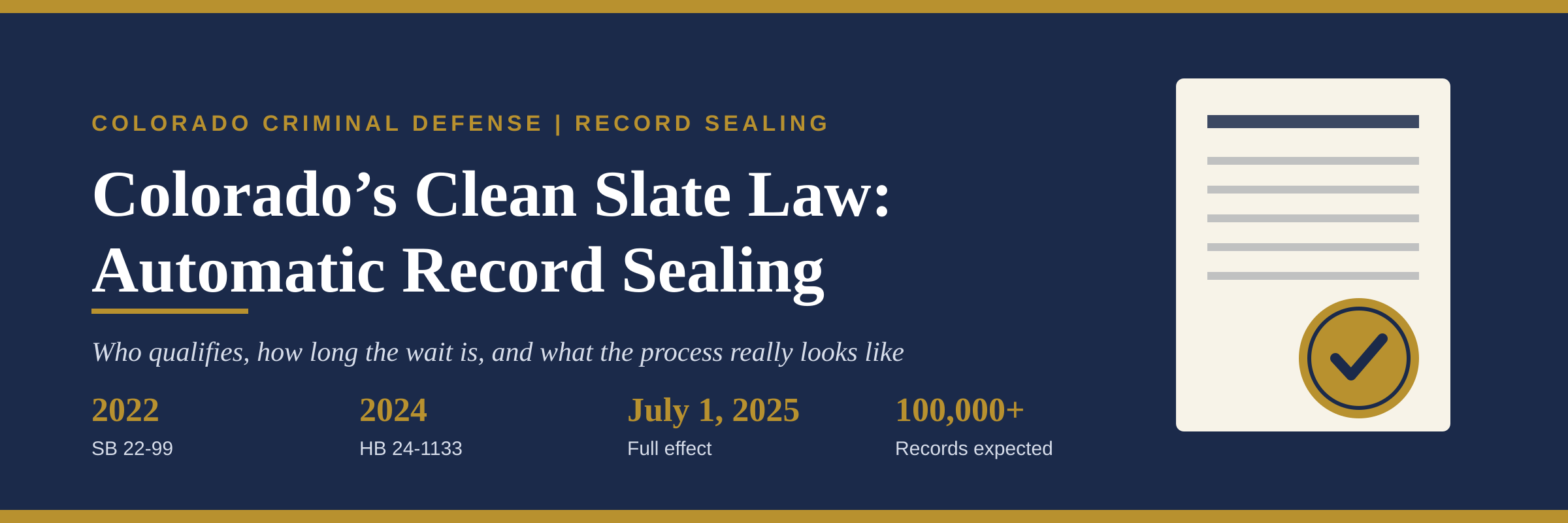
Colorado Automatic Record Sealing: What the Clean Slate Laws Mean for You in 2026
Who qualifies, how long the wait is, how the process really works, and what sealing does (and does not) do under SB 22-99 and HB 24-1133.
Law Office of H. Michael Steinberg | Denver Criminal Defense | October 4, 2026 • 26 min read
In This Article
- Why Record Sealing Matters
- From Petition-Only to Clean Slate: A Short History
- Who Qualifies: The Eligibility Rules
- What SB 22-99 and HB 24-1133 Actually Changed
- Waiting Periods: Petition vs. Automatic Sealing
- How Automatic Sealing Works, Step by Step
- The District Attorney’s Role: Objections and Hearings
- Why Petition-Based Sealing Still Matters
- Putting the Rules Into Practice: Three Hypotheticals
- How to Find Out Whether Your Record Has Been Sealed
- What Sealing Does and Does Not Do
- What This Means If You Are Facing a Charge Today
- Common Misunderstandings
- Frequently Asked Questions
- Practical Steps to Take Now
- The Bottom Line
For most of Colorado’s history, sealing a criminal record was a project. You had to determine whether your conviction was eligible, count the years since your case ended, prepare and file a petition, sometimes appear at a hearing, and then ensure the resulting order reached the agencies that keep records.
People who could not afford a lawyer, or who never learned they qualified, tended to carry old convictions around for decades.
That is no longer the whole story.
Between 2022 and 2025, Colorado built a system in which many eligible records are sealed by the courts on their own, with no petition and no attorney required. The second and final phase of that system took effect on July 1, 2025, so we are now living with the complete structure for the first time. A growing number of people are asking whether their records are already sealed and, if not, when they will be.
This article walks through the answers. It draws on the December 2025 feature “Automatic Record Sealing in Colorado” by Abbey Moffitt Hruby, published in Colorado Lawyer (54 Colo. Law. 26), one of the clearest recent summaries of how the new laws fit together. I have organized the material around the questions I hear most often from people in the Denver metro area:
- who qualifies,
- how long the wait is,
- what actually happens behind the scenes,
- how to find out whether a record has been sealed, and
- what sealing does and does not accomplish.
I have added a defense lawyer’s perspective. Whether a conviction can later be sealed depends on what the conviction is. That makes sealing eligibility a real consideration when a case is being negotiated today, not something to think about only after the case is over.
Key Takeaways
- Two laws did the heavy lifting. SB 22-99 (2022) and HB 24-1133 (2024) created and then expanded automatic sealing. Both were fully in effect by July 1, 2025.
- Coverage is broad. Eligible civil infractions, petty offenses, misdemeanors, and low- to mid-level felonies can now be sealed automatically, along with many non-conviction records.
- Automatic means slower. Waiting periods range from 4 to 10 years under the automatic process, compared with 1 to 5 years with a petition.
- Many offenses are excluded. DUI, DWAI, domestic violence, sex offenses, crimes of violence, and several other categories are generally not eligible for sealing.
- “Automatic” still has steps. The process involves lists, objections, court orders, and a handoff to the Colorado Bureau of Investigation, and it has experienced delays. Verify rather than assume.
- Sealing is not erasure.Courts, prosecutors, and law enforcement can still see a sealed record, and it does not vacate a conviction.
Why Record Sealing Matters
Criminal records follow people long after a sentence ends. A widely cited 2014 report from The Sentencing Project found that about one in three American adults has been arrested by age 23.
By the time Colorado passed its first automatic-sealing law in 2022, roughly three in ten Coloradans had an arrest or conviction record, according to figures cited by the Clean Slate Initiative.
The burden does not fall evenly: the research the article cites indicates that communities of color, LGBTQ+ individuals, and people with a history of mental illness are disproportionately affected.
The day-to-day consequences are practical. A record can surface in an employer’s background check, a landlord’s screening report, a professional-licensing application, or a volunteer-clearance form for a child’s school.
The National Inventory of Collateral Consequences of Conviction lists 671 potential collateral consequences of a conviction in Colorado alone, touching areas such as employment, housing, education, and professional licensing.
Sealing reaches beyond the individual. Parents who can get hired, rent a home, earn a promotion, pursue more schooling, or volunteer at their children’s activities change the trajectory of a household. That generational effect is a major part of the case for building an automated system rather than leaving relief to those with the time, money, and knowledge to petition.
From Petition-Only to Clean Slate: A Short History
Until very recently, a petition was the only way to seal a Colorado conviction. Before 2019, the statutes mostly allowed sealing of drug convictions, petty and municipal offenses, and charges that did not end in a conviction.
Lawmakers significantly widened eligibility in 2019 and again in 2021, extending the petition process to a broader group of misdemeanors and to low- and mid-level felonies. The 2021 session also introduced a limited automatic mechanism for certain drug offenses, marking the first crack in the petition-only model.
The real shift came with Senate Bill 22-99 in 2022. Colorado became the seventh state to enact clean slate legislation, following Pennsylvania, Utah, Connecticut, Michigan, Delaware, and Oklahoma. According to the article, 13 states and the District of Columbia now have some form of clean-slate law, so Colorado is part of a national movement rather than an outlier.
SB 22-99 did not rewrite who may seal a record. It kept the existing eligibility rules and added a second path: instead of waiting for individuals to file, the courts would work from periodic lists of eligible convictions and enter sealing orders on their own.
Two years later, House Bill 24-1133 filled in gaps, particularly for non-conviction outcomes such as completed deferred judgments and diversions. The article reports that the new process was expected to seal more than 100,000 existing records, with more to follow as additional cases age into eligibility.
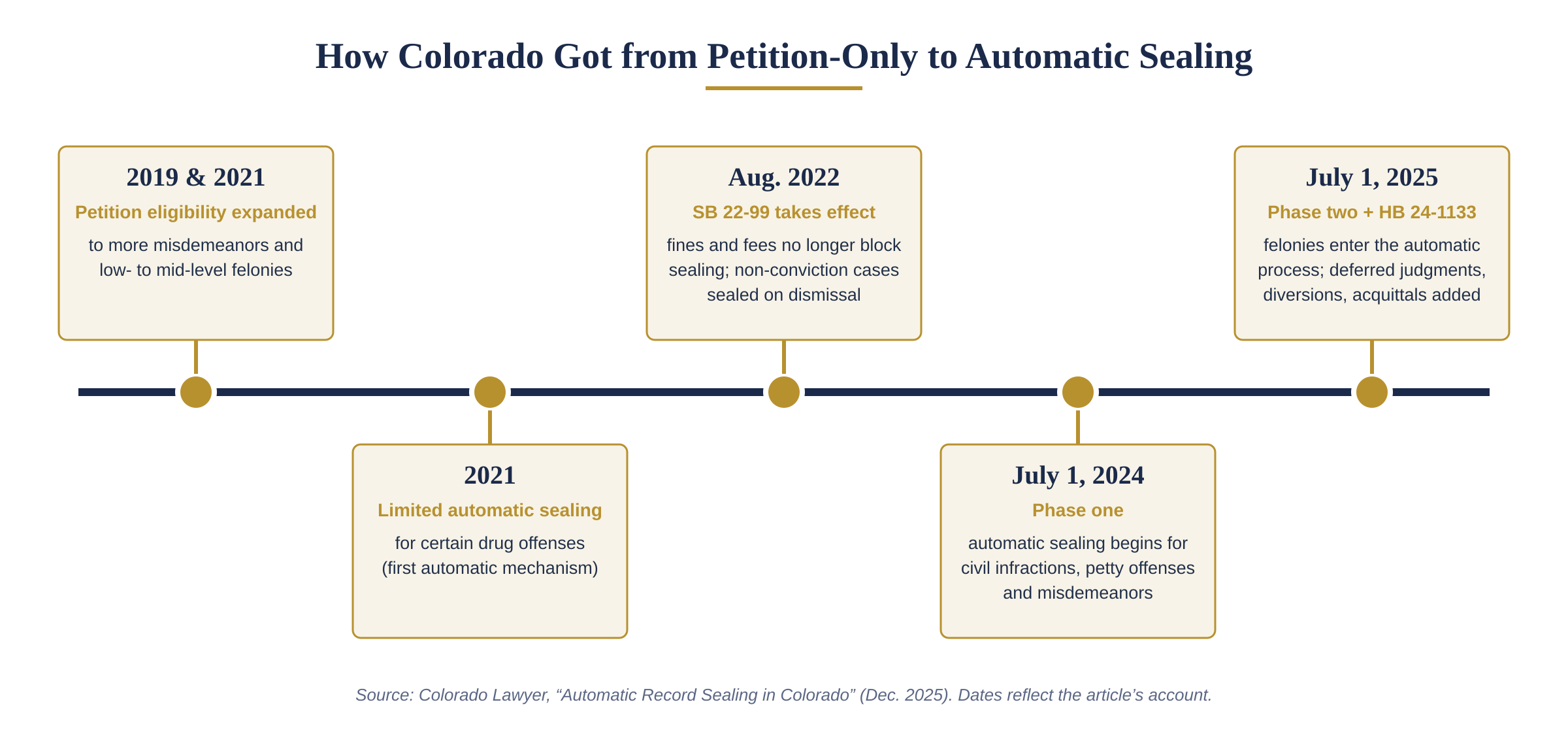
One feature of the rollout matters for anyone checking on an older case. The automatic process was phased in. Eligible civil infractions, petty offenses, and misdemeanors entered the automatic process on July 1, 2024, while eligible felonies followed on July 1, 2025.
A felony conviction, therefore, could not have been sealed automatically before mid-2025, even if the person had waited many years.
Who Qualifies: The Eligibility Rules
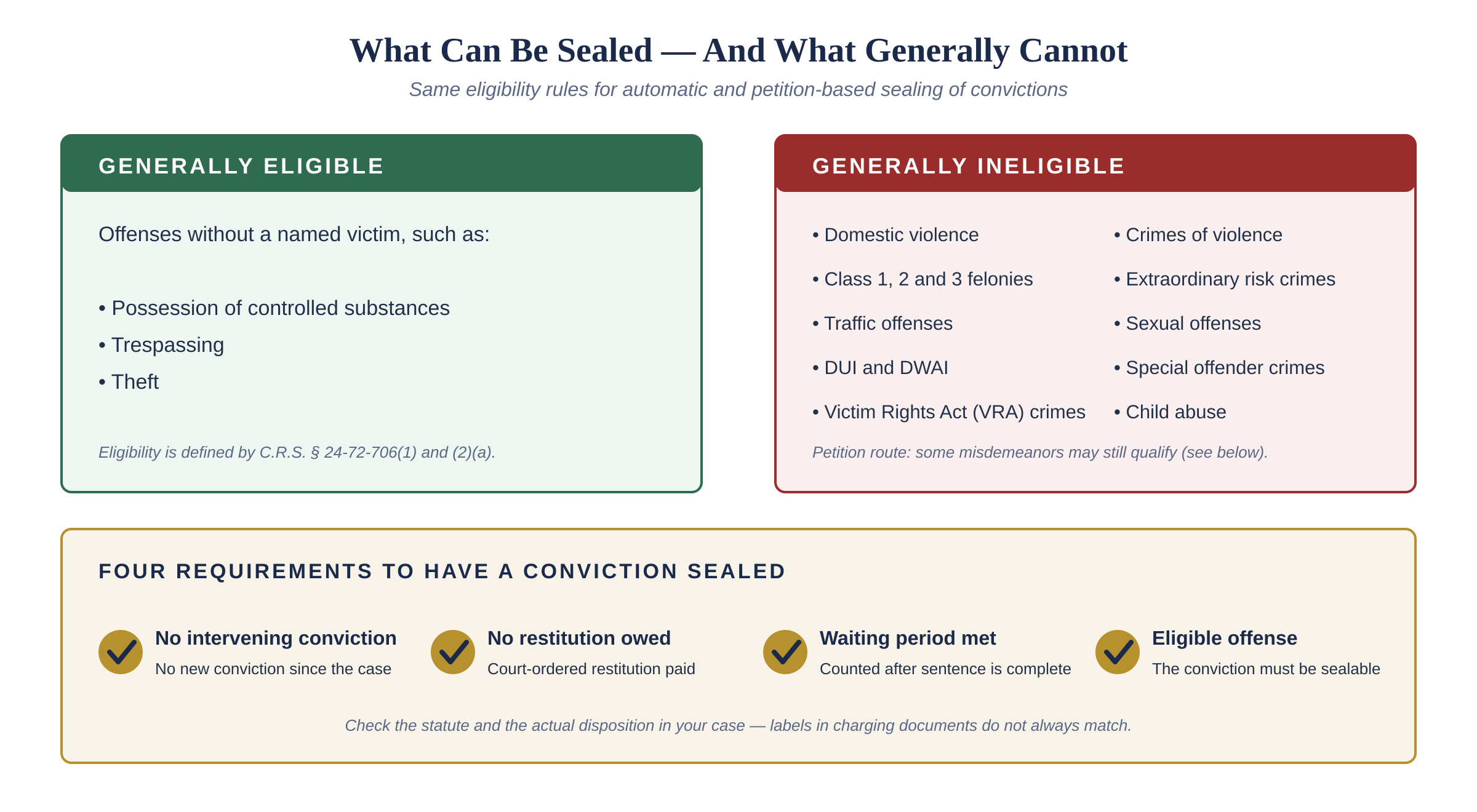
The most important thing to understand about eligibility is that the automatic and petition-based processes use the same criteria. The difference between them is mostly timing and procedure. If a conviction is not eligible for sealing by petition, it will not be sealed automatically either.
Which offenses can be sealed?
Only a limited list of offenses can be sealed, as set out in C.R.S. § 24-72-706(1) and (2)(a). As a general matter, eligible offenses are those without a named victim. Convictions for possession of controlled substances, trespassing, and theft are typical examples.
Many offenses are off the table.
The article lists domestic violence; class 1, 2, and 3 felonies; traffic offenses; driving under the influence and driving while ability impaired; Victim Rights Act (VRA) crimes; crimes of violence; extraordinary risk crimes; sexual offenses; special offender crimes; and child abuse.
For a criminal defense practice, two entries on that list deserve emphasis: DUI/DWAI and domestic violence convictions are generally not sealable through the ordinary process. We return to what that means for people facing those charges now in a later section.
 The four requirements
Even when an offense is eligible, the person must meet four conditions:
- No intervening conviction. A new conviction after the one being sealed generally defeats eligibility. In the automatic process, a pending criminal charge can also be a ground for the prosecutor to object.
- No unpaid restitution. Court-ordered restitution to a victim must be satisfied. Importantly, as discussed below, unpaid fines, fees, and costs are no longer a barrier.
- The waiting period has run. The clock starts after the sentence is complete, and its length depends on the offense level and on whether you are using the petition or the automatic route.
- The offense itself is eligible.The conviction must fall within the sealable categories described above.
Statutory Anchor Points
- C.R.S. § 24-72-706: eligibility, waiting periods, and the balancing test for petition-based sealing of convictions
- C.R.S. § 13-3-117: the automatic sealing process administered by the State Court Administrator
- C.R.S. § 24-72-703: effects of sealing and access to sealed records
- C.R.S. § 24-72-711: sealing convictions for conduct that is no longer prohibited (added by HB 24-1133)
What SB 22-99 and HB 24-1133 Actually Changed
It is easy to describe these laws as “automatic sealing” and stop there, but the two bills did more than that. Here is how the article summarizes each.
SB 22-99 (2022)
- Automatic sealing of convictions.Eligible civil infractions, petty offenses, and misdemeanors began in the automatic process on July 1, 2024. Low- to mid-level felonies followed on July 1, 2025.
- Fines, fees, and costs no longer block sealing. Effective August 2022, owing court costs no longer keeps an otherwise-eligible person from sealing a record. Restitution is the exception, because it is owed to a victim.
- Non-conviction records sealed at dismissal. Also effective August 2022, when a case ends without a conviction, the court may seal the records on its own motion at the time of dismissal.
HB 24-1133 (effective July 1, 2025)
The follow-up legislation expanded the 2022 law in several practical ways:
- More non-conviction outcomes are sealed automatically. Successfully completed deferred judgments, diversion agreements, and cases ending in a complete acquittal now fall within the automatic process.
- Conduct that is no longer a crime.A person convicted of conduct the legislature has since decriminalized, such as possession of natural medicine under C.R.S. § 18-18-434, may seal the conviction under the new C.R.S. § 24-72-711.
- Split pleas.Where a person entered a split plea that included a deferred judgment, a successfully completed deferred judgment can now be sealed.
- Lower costs. Motions to seal arrest records that should have been sealed automatically under C.R.S. § 24-72-704(the provision covering arrests where no charges were filed) are now free. Multiple convictions in the same jurisdiction can be sealed in a single filing, and filing fees are waived in certain mistaken-identity cases.
- Better access. Remote hearings are allowed for all sealing matters. In VRA non-conviction cases where the victim objects, the defendant does not have to appear at the return date. A defense attorney may also view a sealed record with the client’s written permission.
The access provisions are easy to overlook but meaningful.
For someone who has moved out of state, works shifts, or cannot easily travel to a courthouse, the ability to participate remotely can be the difference between pursuing relief and giving up.
Likewise, allowing an attorney to review a sealed record with written permission closes a practical gap: a lawyer cannot evaluate what happened in a case, or what is still open, if the file is locked away from the very person who is trying to understand it.
Why the Non-Conviction Changes Matter
Arrests and charges that never produced a conviction can still appear on background checks and cause real harm. By sealing dismissed cases, completed deferred judgments, completed diversions, and acquittals on an automated track, the 2022 and 2024 laws address people whose cases did not end in a conviction.
Waiting Periods: Petition vs. Automatic Sealing
If there is one number-heavy topic worth studying, it is this one. The central tradeoff between the two paths is time. Automatic sealing asks you to wait considerably longer than a petition does, in exchange for not having to do anything.
The petition clock
Under the petition process, you wait a set number of years after the later of two dates: the final disposition of the case, or your final release from supervision. In practice, that usually means the day you finished probation or parole, though it can also be the day a jail sentence ended or a fine was paid.
The article summarizes the petition waiting periods as one year for civil infractions, petty offenses, and petty drug offenses; two years for class 2 and 3 misdemeanors and drug misdemeanors; three years for class 1 misdemeanors, class 4, 5, and 6 felonies, and class 3 and 4 drug felonies; and five years for all other eligible offenses.
The automatic clock
The automatic waiting periods are much longer: four years after final disposition for civil; seven years after final disposition for petty offenses and misdemeanor convictions; and ten years for felonies, measured from the final disposition or release from supervision, whichever is later.
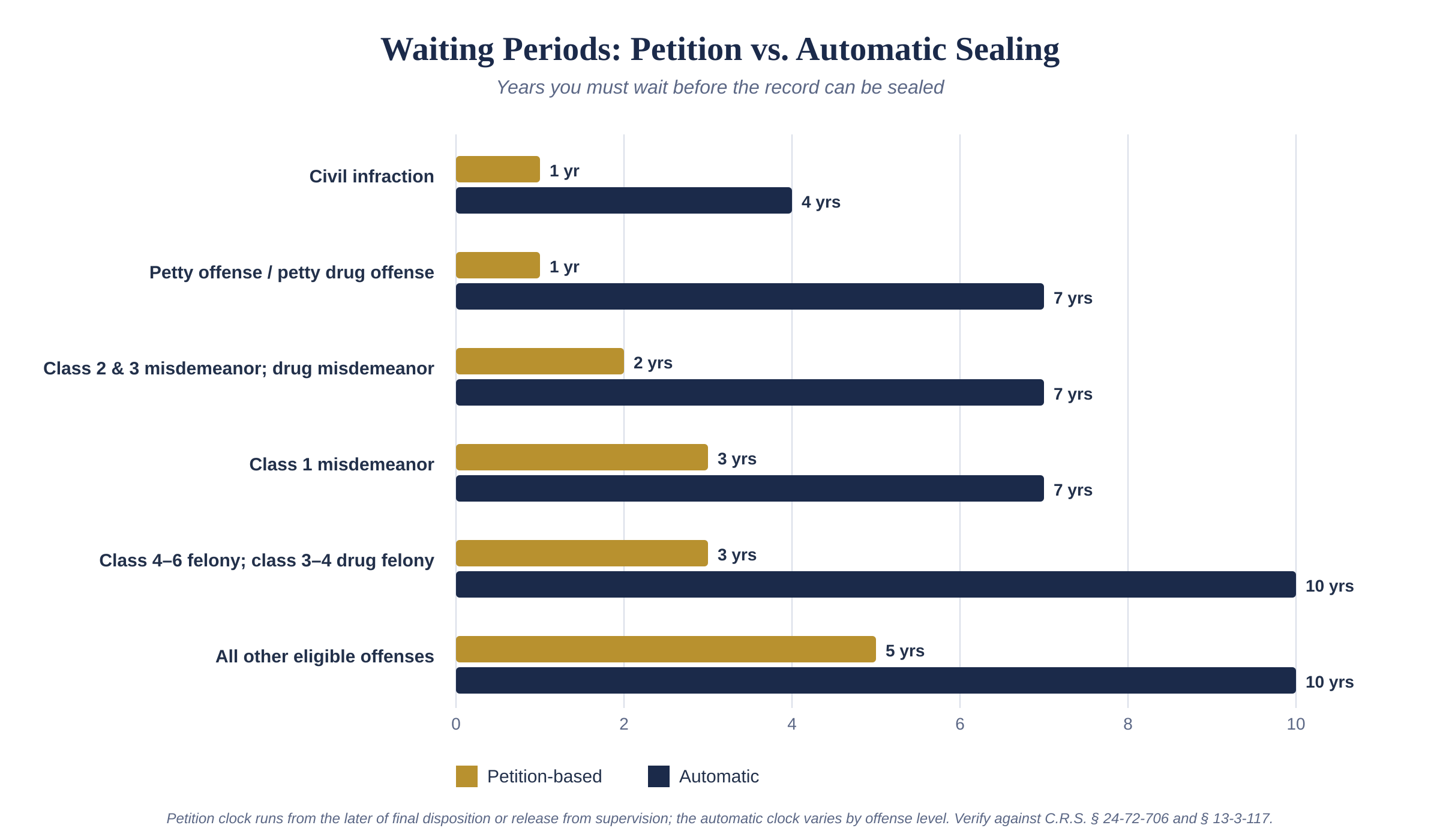
| Eligible Offense | Petition Wait | Automatic Wait |
|---|---|---|
| Civil infraction | 1 year | 4 years |
| Petty offense and petty drug offense | 1 year | 7 years |
| Class 2 and 3 misdemeanor; drug misdemeanor | 2 years | 7 years |
| Class 1 misdemeanor | 3 years | 7 years |
| Class 3 and 4 drug felony; class 4, 5, and 6 felony | 3 years | 10 years |
| All other eligible offenses | 5 years | 10 years |
Note: the article’s narrative and its table group certain drug-felony levels slightly differently, so if your case involves a drug felony, confirm the exact classification and waiting period in C.R.S. § 24-72-706(1)(b) before relying on any summary.
A subtle timing difference
The article points out an easily missed wrinkle. For civil infractions, petty offenses, and misdemeanors, the automatic clock runs from the “final disposition,” which arguably could be the sentencing date.
For felonies, it runs from the later of final disposition or release from supervision. Because probation and parole can add years to a sentence, the practical effect may be that the automatic waiting period for lower-level offenses is shorter than the headline numbers suggest.
Consider a hypothetical class 1 misdemeanor with a sentence imposed in January 2019 and two years of probation completed in January 2021.
By petition, the three-year wait would end in January 2024.
Under the automatic process, if “final disposition” means the sentencing date, seven years would end in January 2026. The petition still comes first, but the gap is smaller than seven versus three would imply.
A felony with a long probation term works the other way: the ten-year automatic clock does not begin until supervision is over.
Practical Rule of Thumb
If you are eligible by petition but have not yet reached the automatic waiting period, you do not have to wait. A petition can get the record sealed years earlier. If you are not in a hurry, and the offense is clearly eligible, the automatic process may eventually do the work for you at no cost.
How Automatic Sealing Works, Step by Step
The article describes the process under the new laws as more “automated” than “automatic,” and that is a fair characterization. A series of administrative steps must occur, and several different offices have to hand the same list of cases to one another. Understanding the sequence helps explain both how records get sealed and why some seem to take longer than expected.
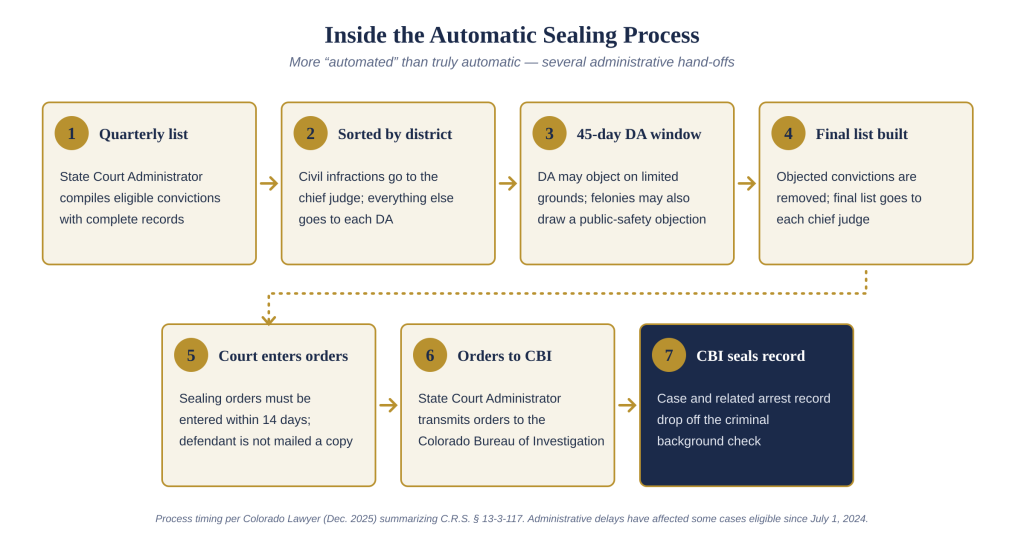
The quarterly list. Each quarter, the State Court Administrator (SCA) compiles a list of eligible conviction records. The list includes only convictions with complete dispositional information and excludes any record the SCA cannot verify. The SCA began compiling lists for petty offenses and misdemeanors on July 1, 2024, and for felonies on July 1, 2025.
- Sorting by district. The SCA sorts the list by judicial district and separates out civil infractions. The civil-infraction list goes directly to the chief judge of each district. The remainder goes to the district attorney in each jurisdiction.
- The DA’s 45-day window. Each district attorney has 45 days to object to the inclusion of any conviction on the list. (The grounds for objection are covered in the next section.)
- The final list.After the objection period, the SCA removes any convictions the DA objected to, compiles the final list, and sends it to the chief judge of each judicial district.
- Court orders. The courts must enter the sealing orders within 14 days. Copies go to the DA and the SCA. Notably, a copy is not mailed to the defendant.
- Transmission to the CBI. The SCA electronically sends the sealing orders to the Colorado Bureau of Investigation.
- Sealing at the CBI. The CBI seals the cases so that the case record and the associated arrest record no longer appear on the person’s criminal background check.
Two observations follow. First, the system works from the court’s own data, which is why the “full dispositional information” requirement matters. A conviction that cannot be verified is skipped, not guessed at. Older cases, or cases with incomplete electronic records, may therefore not appear on a list even though the person appears to qualify.
Second, the article notes that administrative delays have kept this process ongoing for many cases that became eligible on July 1, 2024. Someone who qualified on paper two years ago may not yet have a completed seal at the CBI.
Nothing in this process notifies the person whose record is being sealed. There is no letter announcing that a conviction was placed on a list, and no mailed copy of the order at the end. That design choice is efficient for the courts, but it leaves the individual with the responsibility to check, which is why the verification steps later in this article matter.
The District Attorney’s Role: Objections and Hearings
The automatic process is not unconditional. Prosecutors have a defined opportunity to remove convictions from the list, and the grounds for doing so depend on the type of offense.
Misdemeanors and petty offenses
For misdemeanors and petty offenses, the district attorney may object for only four reasons:
- A condition of the plea agreement would be that the defendant would not seek to have the record sealed.
- The defendant has a pending criminal charge.
- The defendant has an intervening conviction.
- The conviction is ineligible for sealing in the first place.
For these objections, the DA files a notice with the court in the original criminal case but need not serve it on the defendant. That is another reason the person may never know an objection occurred.
Felonies and the public-safety objection
For non-drug felony convictions, the DA has an additional option: a public-safety objection.
The statute frames this as a reasonable belief, grounded in supporting facts, that the public interest and public safety in keeping the record accessible outweigh the person’s privacy interest and the record’s adverse consequences. The DA must file a notice explaining the basis for the objection and attaching supporting documents.
Unlike the narrower objections, this one must be served. The court is required to send the notice to the defendant’s last known address and explain in plain language that the defendant may request a hearing.
But the article identifies the obvious difficulty: by the time a felony reaches the ten-year mark, the person’s address may have changed several times. Someone could be overlooked and never learn that a hearing was available. The article advises that individuals should not rely on mail and should check the court’s online Sealed Case Search themselves.
What a hearing looks like
In the automatic process, a hearing is possible in felony cases where the DA raises a public-safety objection. In the petition process, a hearing may occur if the court decides one is necessary or if the defendant asks for it.
In either setting, the court weighs whether the harm to the defendant’s privacy, or the danger of unwarranted adverse consequences to the defendant, outweighs the public interest in keeping the conviction records publicly accessible. Under C.R.S. § 24-72-706, the court must consider at least four factors:
- the severity of the offense,
- the defendant’s criminal history,
- the number and dates of the convictions the person wants to seal, and
- the need of a government agency to maintain the records.
For a person with a single old conviction and a clean record since, those factors tend to point the same direction. For someone with multiple convictions, or with a record that includes recent contact with the system, the analysis becomes more contested.
Why Petition-Based Sealing Still Matters
It would be a mistake to read the new laws as making petition emphasizes that the petition process remains essential for two reasons: it offers shorter waiting periods and waiting periods, and it provides a route for certain offenses that would otherwise be ineligible.
The misdemeanor exception
In the petition-based process, a person may seal certain misdemeanor offenses that fall outside the ordinary eligibility list in C.R.S. § 24-72-706(1) and (2)(a). The article’s example is a domestic violence conviction.
There are two ways in: the district attorney agrees to the sealing, either before or after the petition is filed, or the defendant satisfies an elevated standard.
That elevated standard is demanding. The defendant must show, by clear and convincing evidence, that
(1) the need to seal the record is significant and substantial,
(2) enough time has passed that the petitioner is no longer a threat to public safety, and
(3) public disclosure is no longer necessary to protect or inform the public. Clear and convincing is a higher bar than the usual preponderance standard.
In practice, the article observes, successful petitioners usually have a very limited history. Often the misdemeanor they want sealed is their only conviction. They can also document a specific need: a lost job opportunity, a housing denial, a barrier to school or volunteer work, a professional license they cannot obtain, or an obstacle to civic participation or career advancement. Supporting documentation, including proof of employment denials where available, strengthens the petition.
When there is no paper trail
A recurring challenge is that people often cannot prove they were turned down because of a record. Employers and landlords do not always say why they passed. The article suggests that, depending on the circumstances, an advocate can argue that the person stopped applying because they expected rejection, or that the employers’ silence was itself caused by the record. In other words, the chilling effect of a record on a person’s ambition can be part of the showing.
Other petition-side features
- Remote hearings are allowed in all sealing matters, which lowers the practical barrier to petitioning.
- Several convictions in the same jurisdiction can be sealed through one filing, saving time and expense.
- The Colorado Judicial Branch publishes self-help forms for petition-based sealing on its website, and the article points readers to earlier Colorado Lawyer pieces by Judge Gordon P. Gallagher for the mechanics of filing.
Putting the Rules Into Practice: Three Hypotheticals
Abstract timelines are easier to grasp with examples. The following scenarios are invented for illustration, use the waiting periods summarized above, and assume the offenses are eligible, no restitution is owed, and there is no intervening conviction.
A misdemeanor from 2017.A person is sentenced in March 2017 for an eligible class 2 misdemeanor and finishes probation in March 2018. By petition, the two-year wait ran out in March 2020.
Under the automatic process, seven years from the final disposition, which arguably means the sentencing date, would have arrived in March 2024, shortly before the first automatic lists began in July 2024. This person would have been among the earliest candidates, so the record may already be sealed, or may be sitting in a delayed queue. The right move is to check the Sealed Case Search, not to assume.
A dismissed case from 2023.A case is dismissed outright. Because non-conviction records may be sealed on the court’s own motion at the time of dismissal, there may be nothing to wait for. The person’s task is to confirm that the sealing happened and, if it did not, to ask the court to correct it.
A low-level felony from 2018. A person finishes probation on an eligible felony in June 2018. The three-year petition wait ended in June 2021, so a petition is available now, although the court will weigh the four statutory factors and the DA may weigh in. The automatic process would not reach this person until June 2028, ten years after release from supervision. Waiting is the no-cost option, but it is also a ten-year option.
Each example turns on the same questions: what the offense is, when the sentence and supervision ended, whether anything intervened, and whether the court and the CBI actually completed the work.
How to Find Out Whether Your Record Has Been Sealed
Because nobody is required to tell you, verification is on you. The article describes two main tools, both through the Colorado Judicial Branch.
The Sealed Case Search
The Judicial Branch offers an online Sealed Case Search form at coloradojudicial.gov/sealed-case. It lets a person check whether a particular conviction has been sealed. There are two catches. You need to know your case number, which can be hard to find if years have passed, and you need either a driver’s license number or a Social Security number to access your record.
Records requests
If you do not have your case number or want a copy of the actual Order to Seal, you will need to request your court records from the county where the case was filed. The Judicial Branch’s Record/Document Request Form (coloradojudicial.gov/recorddocument-request-form) is the vehicle. The article advises specifying in the “Other Documents”section that you are seeking a copy of the Order to Seal, if one exists. Depending on your circumstances, you may not need a certified copy, and the CBI does not require one.
Check the background-check side, too
A court order and a cleaned-up background report are two different things. The order is entered first, and the CBI then seals the case, so it no longer appears on the criminal background check. Since administrative delays have been reported, someone who needs a clean report for a job or lease should confirm that the sealing has actually been processed, not merely ordered. Ordering a copy of your own background report is a reasonable way to see what an employer or landlord might see.
For cases that ended without a conviction, the Judicial Branch’s January 2026 training materials indicate that a person whose record is eligible for sealing but has not been sealed can still file a motion in the county where the case occurred, and that no fee applies to that motion. If you believe a dismissed or acquitted case should already be sealed, that route is worth exploring.
What Sealing Does and Does Not Do
Managing expectations is part of doing this work well. A sealing order is valuable, but it is narrower than many people assume, and the article is careful to explain both sides.
The limits
In Colorado, a sealed record remains accessible to the courts, prosecutors, government agencies that are required to conduct background checks, and law enforcement (C.R.S. § 24-72-703(2)). A practitioner should tell clients plainly that the government will probably always have access. Sealing does not vacate a conviction, and it does not have the effect of a pardon. And if a person is convicted of a new offense after the sealing order is entered, the court shall order the conviction records unsealed.
The benefits
Within those limits, the relief is considerable. Once a case is sealed, both the defendant and all criminal justice agencies may respond that the public criminal records do not exist. On applications to employers, landlords, state and local government agencies, or any other entity, the person does not have to disclose the sealed record and may state that they have not been convicted. And an application cannot be denied for failing to disclose a sealed record.
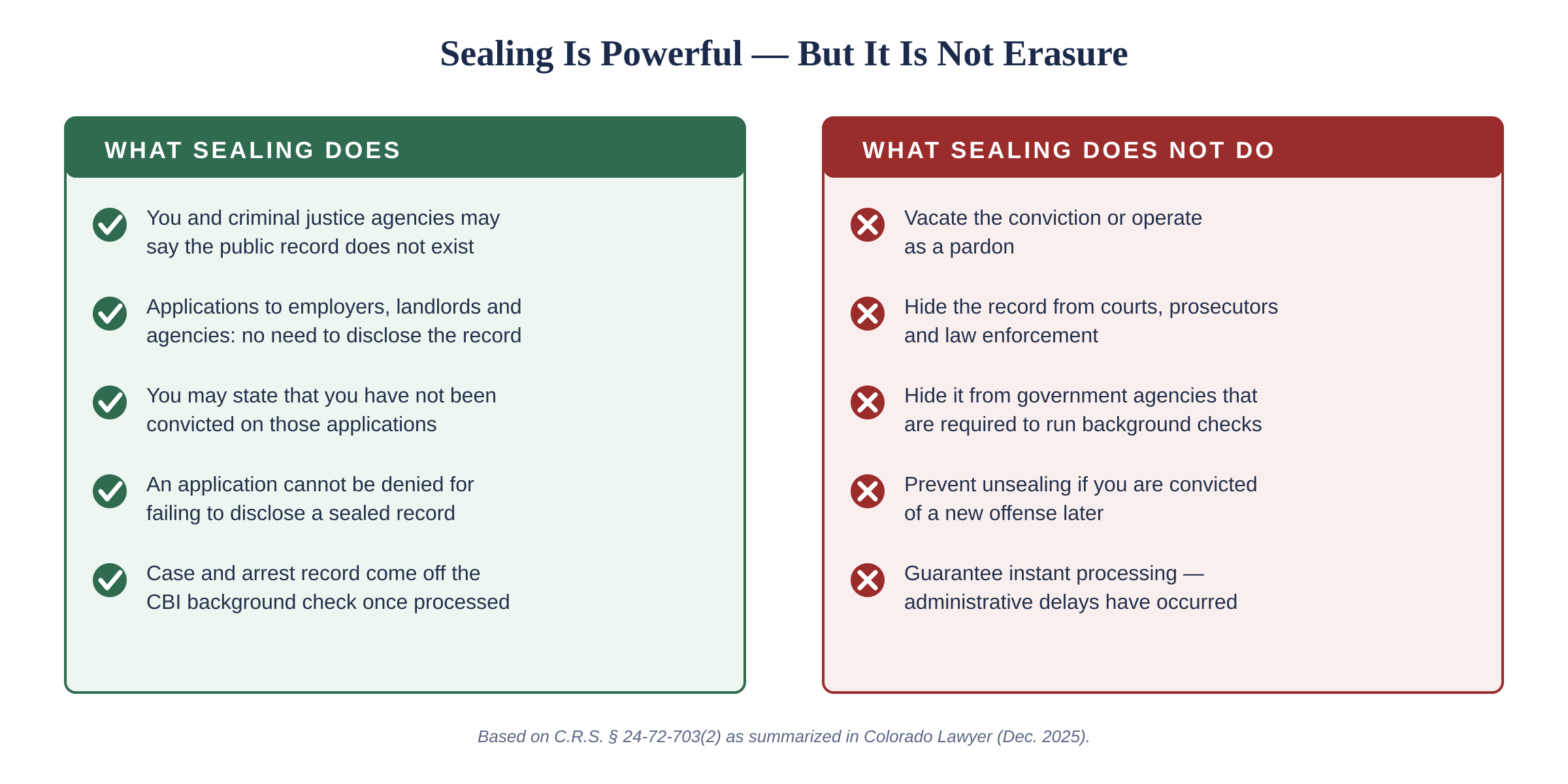
That last protection is worth underscoring. For many people, the most stressful moment is not the background check itself but the application question: Have you ever been convicted of a crime? Under Colorado law, a person with a sealed record can answer that question without fear that the answer will later be treated as a misrepresentation.
What This Means If You Are Facing a Charge Today
Most discussions of sealing are written for people looking back at an old case. But the structure of these laws has real implications for people who are in the middle of a case now, and for the choices made in negotiating it. The following points flow from the article’s description of the rules.
The offense of conviction controls everything
Eligibility depends on the nature of the conviction. Because DUI, DWAI, other traffic offenses, domestic violence, and sex offenses are generally not sealable through the ordinary process, a conviction of that type is likely to remain on the public record. That raises the stakes of defending those cases at the front end. Exposing a weak stop, challenging a breath or blood test, or negotiating to an eligible offense may be the only chance to avoid a lasting public record.
Read the plea paperwork carefully
One of the four grounds on which a prosecutor may object to automatic sealing of a misdemeanor or petty offense is that the defendant agreed, as a condition of the plea, not to have the record sealed. A provision like that can be easy to skim past in the moment, especially when the focus is on avoiding jail. Before signing, a defendant should understand whether the agreement includes any limit on future sealing, and weigh what that limit may cost years later.
Deferred judgments and diversion can lead to automatic sealing
Under HB 24-1133, successfully completed deferred judgments and diversion agreements are within the automatic process, and the law now also addresses deferred judgments that were part of a split plea. Where a case can reasonably be resolved through one of those structures, the long-term payoff may include a record that is sealed without a petition. Completing every condition is essential, because the benefit depends on successful completion.
A new case can undo an old opportunity
An intervening conviction defeats eligibility, and a pending charge is a ground for the DA to object. A person who is five years into a waiting period and gets a new charge may find the clock effectively stops mattering. That is worth remembering for anyone who is close to eligibility: staying out of trouble is not just good advice, it is a legal requirement for the relief.
Restitution is a gate; fines and fees are not
Unpaid restitution still bars sealing, while unpaid fines, fees, and costs no longer do. When negotiating a case that involves a victim’s losses, how restitution is determined and paid can influence whether sealing becomes available later.
Common Misunderstandings
- “Everything gets sealed automatically.” No. Only eligible offenses are sealed, and only after the longer automatic waiting periods and the administrative steps.
- “Sealing is the same as expungement or a pardon.” It is not. A sealed conviction is not vacated, and it remains available to courts, prosecutors, law enforcement, and agencies required to run background checks.
- “Petitions are pointless now.”The petition route still offers shorter waits and, for certain misdemeanors, a path that the automatic process does not.
- “I will get a notice when it happens.” Not necessarily. Copies of sealing orders are not mailed to defendants, and certain DA objections need not be served on them.
- “Unpaid court costs are holding me back.” Since August 2022, fines, fees, and costs are no longer a barrier. Restitution still is.
- “A DUI will eventually be sealed.” DUI and DWAI are on the list of generally ineligible offenses.
 Frequently Asked Questions
When did automatic record sealing begin in Colorado?
Automatic sealing of eligible civil infractions, petty offenses, and misdemeanors began on July 1, 2024. Eligible felonies entered the process on July 1, 2025. Some non-conviction sealing provisions took effect earlier, in August 2022, and HB 24-1133 added further non-conviction categories effective July 1, 2025.
Can a felony be sealed automatically in Colorado?
Yes, if it is an eligible offense and the person meets the requirements, including the ten-year waiting period measured from the later of final disposition or release from supervision. Class 1, 2, and 3 felonies are generally not eligible, and prosecutors may raise a public-safety objection to non-drug felony sealing.
Can I seal a DUI or a domestic violence conviction?
DUI, DWAI, and domestic violence convictions are generally ineligible under the ordinary sealing rules. For certain misdemeanors outside the standard list, the petition process includes an exception that requires either the prosecutor’s agreement or proof by clear and convincing evidence. Whether a specific offense qualifies depends on the statute and your history, so it should be reviewed by a lawyer.
Do I need a lawyer for automatic sealing?
Not to start the process, since the courts initiate it. But a lawyer can help you confirm eligibility, check whether sealing was completed, respond to a DA objection, or pursue a petition if you do not want to wait for the automatic timeline.
What if my record should have been sealed but was not?
Start with the Sealed Case Search or a records request to find out what the court shows. Delays and incomplete records can cause cases to be missed, and you may have the option to file a motion or petition. An attorney can tell you which applies.
Can I say I was never convicted after my record is sealed?
Under the provisions the article summarizes, a person with a sealed record is not required to disclose it on applications to employers, landlords, and government agencies, and may state that they have not been convicted. An application cannot be denied for failing to disclose a sealed record. If the record is later unsealed because of a new conviction, that protection changes.
Does sealing remove a conviction from every database?
No. Courts, prosecutors, law enforcement, and agencies required to conduct background checks retain access, and the CBI’s processing can lag behind the court’s order.
Practical Steps to Take Now
- Gather your case information.Find your case number, county, offense, and dates of disposition and release from supervision.
- Identify the offense category. Determine whether it is a civil infraction, petty offense, misdemeanor, or felony, and whether it is on the ineligible list.
- Count the waiting period. Calculate both the petition and automatic dates and note whether any intervening conviction or unpaid restitution applies.
- Run the Sealed Case Search. Use your case number and driver’s license or Social Security number to see whether the court shows the record as sealed.
- Request the order if needed.Use the Judicial Branch records request form and ask specifically for the Order to Seal.
- Confirm the background report. If you need a clean report for a job or apartment, check that the CBI has processed the order.
- Talk to a lawyer about close calls. Borderline eligibility, a possible public-safety objection, or a misdemeanor exception petition are all situations where experience matters.
The Bottom Line
Colorado’s clean slate laws are among the most significant expansions of record-sealing relief in the state’s history. By shifting the burden from individuals to the courts, they reduce the procedural barriers that kept eligible people from benefiting. The tradeoffs are longer waiting periods for the automatic route, a process that depends on administrative hand-offs, and a continuing need for individuals to verify results themselves. The petition path remains a valuable and sometimes faster alternative, and it is the only route for the narrow set of otherwise ineligible misdemeanors that can be sealed with the prosecutor’s agreement or a strong showing.
For people facing charges now, the lesson is that the long-term life of a case is determined by decisions made at the beginning. What you are convicted of, what you agree to in a plea, and whether you complete a deferred judgment or diversion can determine whether a record is ever sealed. For people with older cases, the lesson is to check, count, and verify rather than assume.
Questions About Sealing a Record or Defending a Charge?
The Law Office of H. Michael Steinberg has defended Colorado criminal cases for over forty years, including DUI, domestic violence, drug crimes, sex crimes, and a broad range of felony and misdemeanor charges across the Denver metro area. If you are facing a charge, or want to understand whether an older case can be sealed, we can talk through your situation.
Sources
- Abbey Moffitt Hruby, “Automatic Record Sealing in Colorado,” 54 Colo. Law. 26 (Dec. 2025), cl.cobar.org/features/automatic-record-sealing-in-colorado.
- Colorado Judicial Branch, Sealed Case Search, coloradojudicial.gov/sealed-case.
- Colorado Judicial Branch, Record/Document Request Form, coloradojudicial.gov/recorddocument-request-form.
- Colorado Judicial Branch, Seal My Case self-help forms, coloradojudicial.gov/self-help/seal-my-case.
- Colorado Judicial Branch, Sealing Criminal Records training presentation (Jan. 2026), coloradojudicial.gov.
- C.R.S. §§ 13-3-117, 24-72-701 through 24-72-711 (as cited in the Colorado Lawyer article); SB 22-99; HB 24-1133.
Disclaimer. This article is provided for general educational purposes and is not legal advice. Reading it does not create an attorney-client relationship. Record-sealing law is detailed and changes over time; eligibility depends on the specific offense, disposition, and history involved. Statutory references are drawn from a December 2025 secondary source and should be verified against the current Colorado Revised Statutes. Prior results do not guarantee a similar outcome. Contact a licensed Colorado attorney about your situation.