 Colorado Criminal Lawyer Blog
“I have nothing to hide “- Part 1 of 2 – Why You DO NOT Want To Talk To The Police


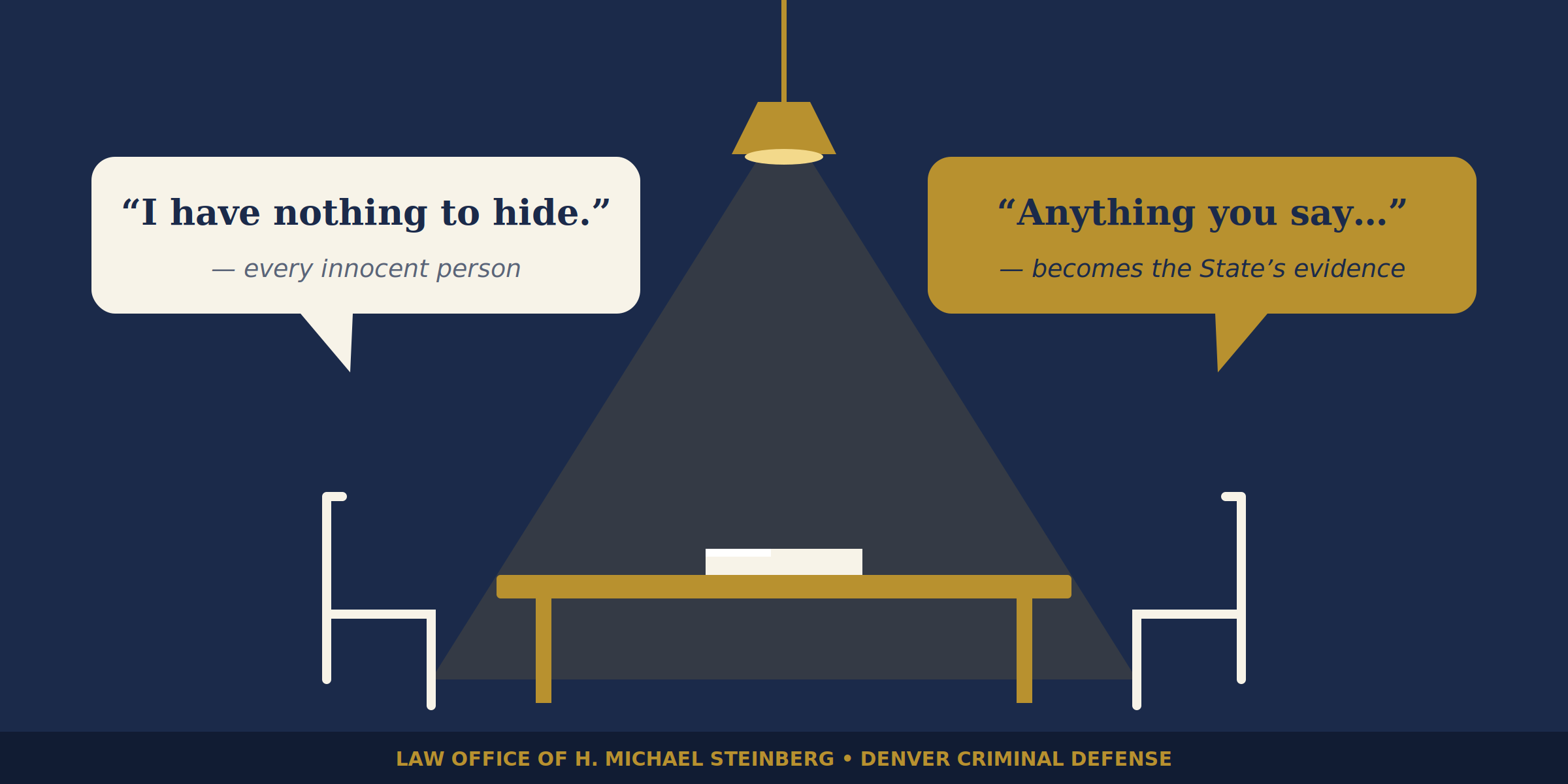
 “I have nothing to hide” is the most natural sentence in the world — and one of the riskiest.
Here is what the research and Colorado law say about why honest people end up building the prosecution’s case for it.
You did not do it. You know you did not do it. A detective asks whether you would mind answering a few questions “so we can clear this up,” and every instinct tells you that cooperating is the fastest way to end the misunderstanding.
That instinct is exactly the problem. Decades of psychological research, DNA exoneration data, and Colorado case law point in the same direction: innocent people often talk to the police because they are innocent, and what they say can become the most damaging evidence in the case.
The Belief That Feels Like Protection
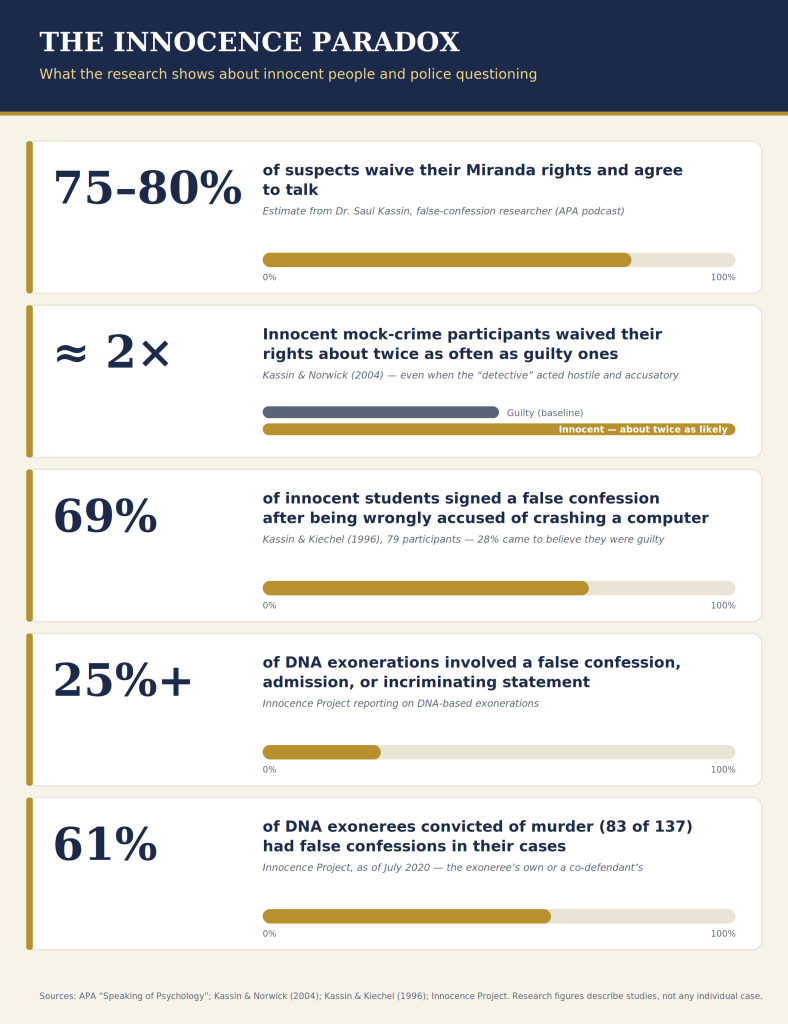
Psychologist Saul Kassin, who pioneered the scientific study of false confessions, has described the core of the problem as a naive faith that truth and justice will prevail. In a mock-crime experiment he ran with Rebecca Norwick, innocent participants were more likely than guilty ones to waive their Miranda rights, even when the “detective”appeared hostile, accusatory, and closed-minded.
Kassin has said the same reasoning explains why innocent people waive their rights at all: they believe the investigation will eventually reveal they had nothing to do with it.
Innocent people signed their Miranda waiver about twice as often as guilty suspects in Kassin’s experiment.
Innocence does not make people cautious. It makes them comfortable.
— Kassin & Norwick (2004); APA, Speaking of Psychology
Kassin estimates that roughly 75 to 80 percent of suspects waive their Miranda rights. Investigators, meanwhile, are not good at telling who is telling the truth. Research summarized by Kassin and Gudjonsson finds that trained police tend to make confident but mistaken judgments of deception, which means an honest person can become the focus of a hard-edged interrogation.
Five Ways an Honest Conversation Goes Wrong
1. Memory is not a recording
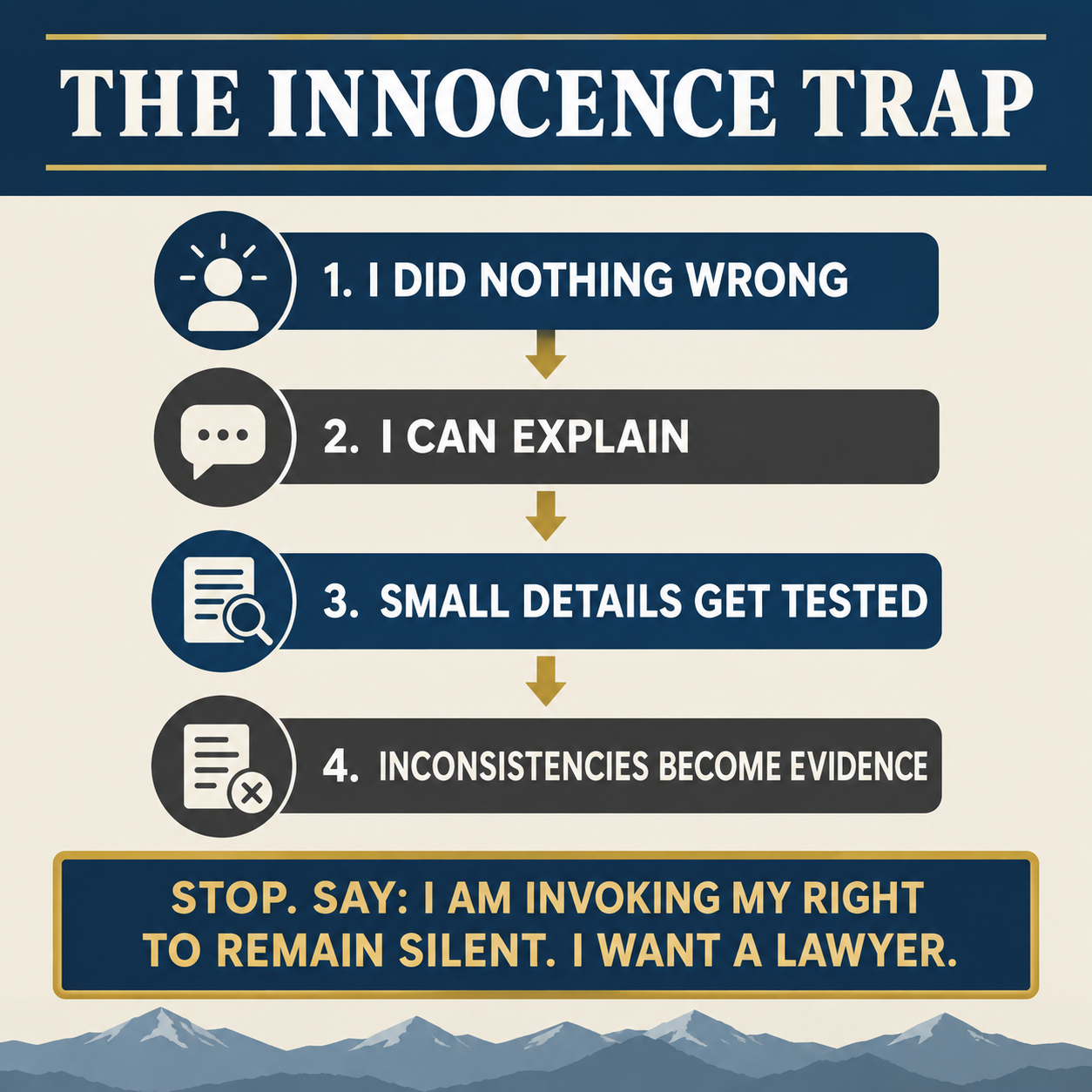
Ask anyone what they were doing at 9:40 last Thursday and the answer will be a reconstruction. Detectives ask for exact times, exact order, exact words. An honest guess stated as a fact becomes a “statement” the State can hold up against your phone records, a doorbell camera, or a witness.
2. Gaps and inconsistencies get labeled as lies
A mistaken detail is not a crime, but it is easy to present as one. A jury that hears, “He told us he was home by nine, and the video shows him at 9:40,” may hear deception rather than a slip. It gets worse if a statement is knowingly false. Under C.R.S. § 18-8-111, providing information about an offense to law enforcement that you know is false can be charged as false reporting to authorities, a class 2 misdemeanor, and knowingly giving false identifying information is separately covered by C.R.S. § 18-8-111.5.
3. Police are allowed to lie to you
In Frazier v. Cupp (1969), the U.S. Supreme Court held that deception alone does not make a confession involuntary; the suspect there was falsely told that his cousin had confessed. Officers may claim evidence they do not have, or overstate what they do have. Police cannot lie about your Miranda rights or make threats that overbear your will, but the tolerance for trickery is wide. Kassin’s research shows why it matters: in the classic 1996 Kassin–Kiechel experiment, 69 percent of students wrongly accused of crashing a computer signed a confession, and 28 percent came to believe they were guilty.
4. Pressure, minimization, and long sessions
Kassin’s review of the science identifies lengthy sessions, false evidence, and “minimization” themes that imply leniency as techniques that increase the risk of an innocent person confessing. Young people and people with mental health problems or intellectual impairments are especially vulnerable. Some innocent people confess because they believe the truth will come out later, which is the same logic that led them to waive their rights.
5. Confessions carry enormous weight
Once a statement is on the record, it is hard to dislodge. Kassin’s research finds that confession evidence increases perceptions of guilt among judges and juries even when they see the confession as coerced, and even when it is contradicted by other evidence. The Innocence Project reports that in more than a quarter of wrongful convictions later overturned by DNA testing, defendants made false confessions, admissions, or incriminating statements, and that 83 of 137 DNA exonerees convicted of murder (61 percent, as of 2020) had false confessions involved in their cases.
What Colorado Law Does — and Does Not — Do for You
Your words are the State’s evidence
Under Colorado Rule of Evidence 801(d)(2), a statement is not hearsay when it is offered against a party and is that party’s own statement. That is why a defendant’s statement to the police can be introduced by the prosecution without the usual hearsay hurdles. The reverse is not true. In People v. Vanderpauye, 2023 CO 42, the Colorado Supreme Court held there is no automatic ban on a defendant’s self-serving hearsay, but such statements still have to fit a recognized hearsay exception, such as an excited utterance. Your carefully explained denial to a detective is not automatically admissible for you, though your admissions are admissible against you.
- CRE 801(d)(2) — a party’s own statement offered against that party is not hearsay.
- C.R.S. § 18-8-111 — false reporting to authorities (class 2 misdemeanor); § 18-8-111.5 — false identifying information.
- C.R.S. § 16-3-601 — recording of custodial interrogations, limited to class 1 and 2 felonies and certain felony sexual assaults conducted in a permanent detention facility.
- Frazier v. Cupp, 394 U.S. 731 (1969) — police deception does not by itself make a confession involuntary.
- Davis v. United States, 512 U.S. 452 (1994) — a request for counsel must be unambiguous; “Maybe I should talk to a lawyer” was not enough.
- Berghuis v. Thompkins, 560 U.S. 370 (2010) — silence alone does not invoke the right to remain silent.
- Salinas v. Texas, 570 U.S. 178 (2013) (plurality) — pre-arrest, pre-Miranda silence was usable where the suspect did not expressly invoke the privilege.
- People v. Vanderpauye, 2023 CO 42 — no per se bar on a defendant’s self-serving hearsay, but an exception is still required.
Miranda is narrower than most people think
Miranda protections apply to custodial interrogation. A voluntary conversation in your kitchen, on your porch, or on the phone often is not custodial, which means the safeguards you know from television may never have attached. Two 2026 Colorado Supreme Court decisions show how much timing and wording matter. In a March 30 decision, the court reversed a suppression order in a Denver case after concluding the defendant was not in custody when he asked for a lawyer, so the protections that follow an invocation of counsel did not apply. Three weeks earlier, on March 9, the court ruled 5–2 that a suspect questioned by a Longmont detective never clearly invoked his right to remain silent and later waived his rights voluntarily, so his statements could be used.
You must be clear, and you must say it out loud
The Supreme Court’s decisions in Davis, Berghuis, and Salinas place the burden on the person being questioned. “Maybe I should talk to a lawyer” did not stop questioning in Davis. Sitting silent for hours did not invoke the right to silence in Berghuis. And in Salinas, a three-justice plurality held that a man who answered some questions and then went quiet when asked about shotgun shells could see that silence used against him because he had not expressly invoked the privilege. Courts look for direct statements, not hints.
Recording is limited
Colorado requires audio-visual recording of custodial interrogations only for class 1 and 2 felony investigations and certain felony sexual assaults, and only for interrogations in a permanent detention facility. Even when officers fail to record, the court may still admit the statement, with an instruction that the failure violated agency policy and state law. Most police conversations, especially early, informal ones, are not recorded at all, leaving a detective’s notes and memory against yours.
What to Do Instead
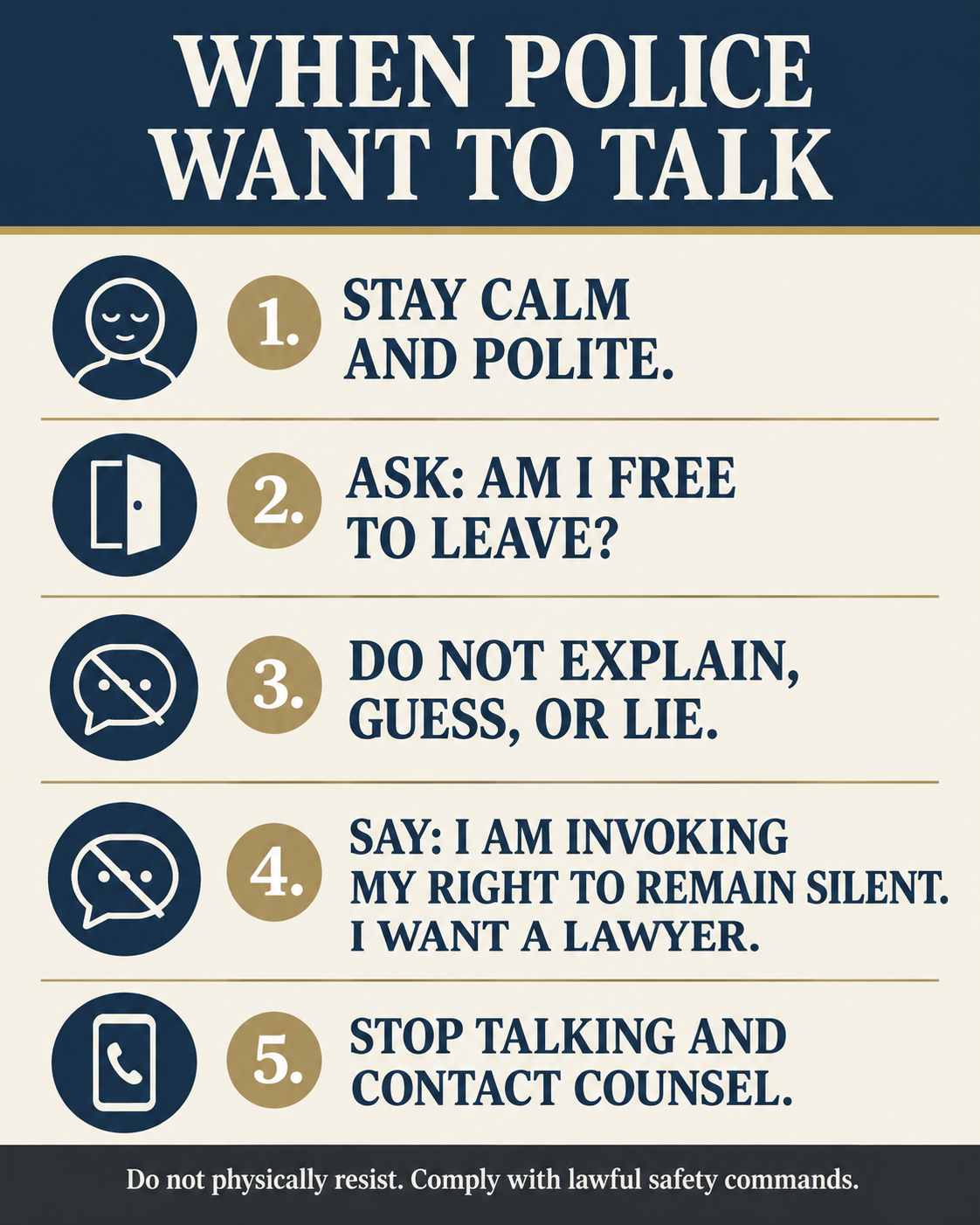
- Be polite and be clear. Say, “I do not want to answer questions. I want a lawyer.” Do not hedge with “maybe” or “should I.”
- Then stop talking. Do not explain, do not “just clear one thing up,” and do not fill silence. Every additional sentence is a new statement.
- Never lie.Give your correct name and basic identifying information, but do not offer a false story or false identifying information. That can create a new charge on top of the one you are worried about.
- Do not consent to searches or sign anything without speaking to a lawyer first.
- Call a criminal defense lawyer before any interview, including one described as voluntary, informal, or “just for background.” Your lawyer can decide whether a statement helps, and can do the talking for you.
 Common Questions
Doesn’t refusing to talk make me look guilty?
Refusing to answer questions is a constitutional right, and it is the position defense lawyers recommend even for innocent clients. In Salinas, the plurality pointed out that a person who is not under arrest and does not want to talk simply has to say so. Whatever a detective may imply, a clear request for a lawyer is far less risky than an inaccurate statement you cannot take back.
What if I already talked to the police?
Stop talking and call a lawyer. Statements can sometimes be challenged on Miranda or voluntariness grounds, but that analysis depends on facts such as custody, what was said, and how the interview was conducted. A lawyer can also decide whether any further statement should ever be made, and how.
Can I ever talk to police?
Sometimes a carefully prepared statement, made through counsel and on the record, can help. That is a strategic decision to make with a lawyer beforehand, not in a hallway.
The Bottom Line
Innocence is a fact about what happened. It is not a legal shield during questioning. Talking to police may feel like the honest thing to do, but for a person under investigation, the safest honest sentence is often a short one: “I want to speak with a lawyer.”
Sources
- APA — Saul Kassin, PhD: False confessions aren’t always what they seem (Speaking of Psychology)
- Kassin (2014), False Confessions, Policy Insights from the Behavioral and Brain Sciences
- Kassin (2017), False confessions, WIREs Cognitive Science
- Kassin & Gudjonsson (2004), The Psychology of Confessions
- Kassin & Norwick (2004), Why People Waive Their Miranda Rights: The Power of Innocence
- Kassin & Kiechel (1996) findings, as summarized by Justice Denied
- Innocence Project — DNA Exonerations in the United States
- Innocence Project of Florida — Contributing Factors
- C.R.S. § 18-8-111 (FindLaw)
- C.R.S. § 18-8-111.5
- C.R.S. § 16-3-601 (FindLaw)
- NACDL — Colorado Recording Interrogations
- Colorado Supreme Court opinion, No. 25SA146 (Mar. 30, 2026)
- Colorado Politics — Divided Colorado Supreme Court finds Denver detective did not violate Miranda rights
- Colorado Politics — Colorado justices, by 5-2, say Longmont detective did not violate suspect’s Miranda rights
- Colorado Bar Association — People v. Vanderpauye, 2023 CO 42
- Salinas v. Texas, 570 U.S. 178 (Justia)
- Berghuis v. Thompkins, 560 U.S. 370 (Cornell LII)
- Davis v. United States, 512 U.S. 452 (1994)
- Frazier v. Cupp — overview
This article is general information about Colorado criminal law and is not legal advice. It does not create an attorney-client relationship. Laws and court decisions change, and every case turns on its own facts. If you are being investigated or have been charged with a crime, speak with a licensed attorney about your situation.