 Colorado Criminal Lawyer Blog
I have nothing to hide – Part 2 of 2 – Why You DO NOT Want To Talk To The Police


By H. Michael Steinberg, A Colorado Criminal Defense Lawyer

Introduction
In part 1 of this article, we did a kind of surface review of this difficult and complex area.
In part 2, I take a much deeper dive into these issues.
The research confirms a counterintuitive pattern: innocent people may be more willing to waive their rights because they expect the truth to clear them, while questioning can create damaging inconsistencies or even false confessions.
Many people assume that only guilty suspects need to remain silent.
If you did nothing wrong, the thinking goes, explaining the situation should clear everything up.
Unfortunately, police questioning does not always work that way.
Even an innocent person can provide inaccurate details, make an incomplete statement, appear inconsistent, or offer information that investigators interpret as evidence of guilt. Stress, ordinary memory limitations, misunderstood questions, and efforts to appear cooperative can all make a truthful person’s account seem suspicious.
The “Power of Innocence” Problem
Innocent people often believe the truth will protect them. They may assume that investigators simply need a few missing facts and that refusing to answer questions will make them look guilty.
Researchers have described this as the “power of innocence” effect.
In an experimental study by Saul Kassin and Rebecca Norwick, innocent participants were more likely than guilty participants to waive their Miranda rights. Their innocence seemed to make them feel safer speaking, even though submitting to questioning posed additional risk.
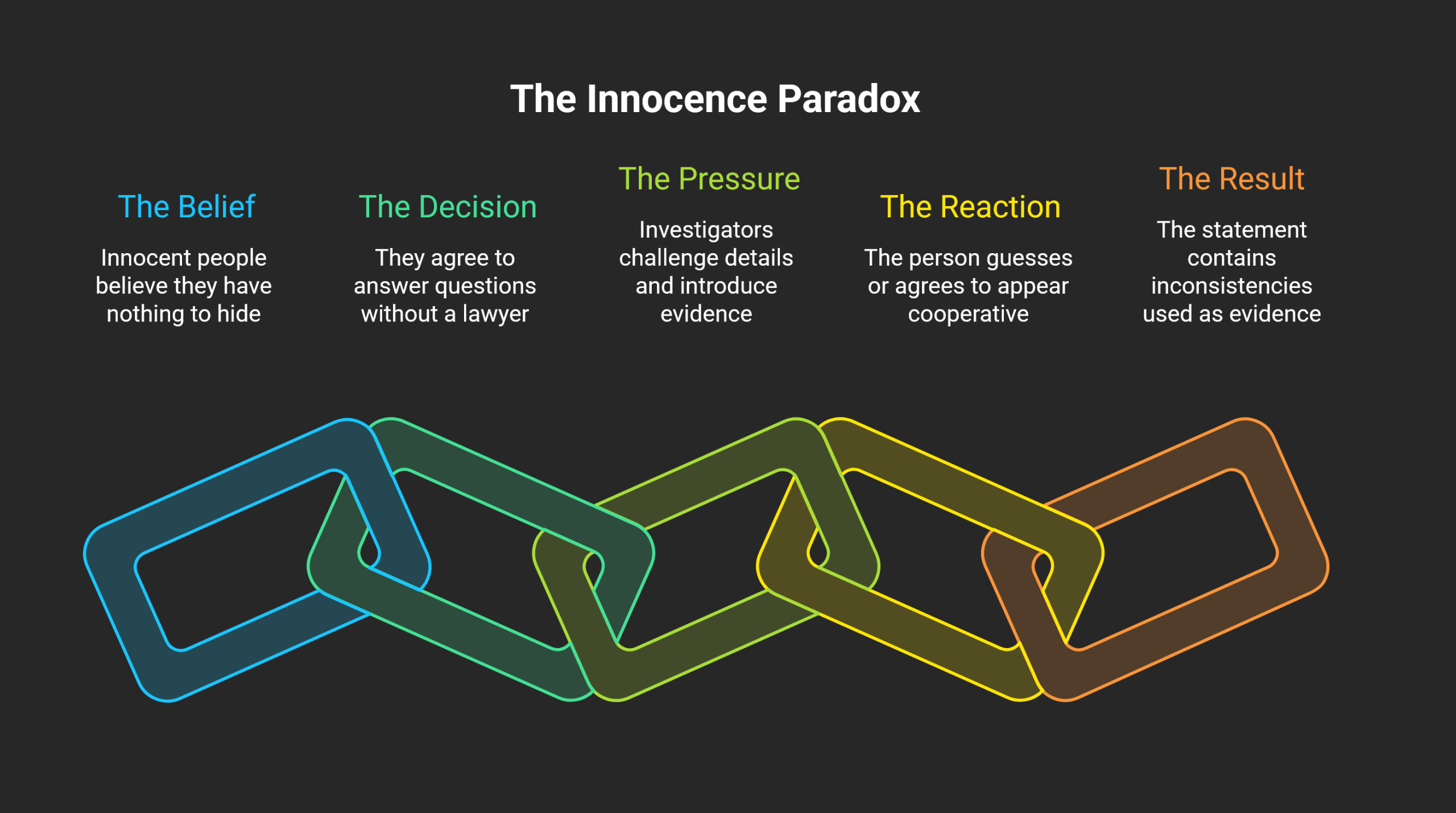
This produces a dangerous paradox:
- Guilty suspects may recognize that speaking could hurt them.
- Innocent suspects may believe speaking cannot hurt them.
- Police may interpret willingness to talk as an opportunity to test, challenge, or disprove the person’s account.
- Minor errors can then be treated as signs of deception.
An innocent person may enter the interview trying to help. Investigators, however, may be trying to obtain admissions, identify contradictions, or lock the person into a detailed version of events.
Those are very different objectives.
 Police Do Not Need a Confession to Use Your Words
The most obvious risk of police questioning is confessing to an offense. But investigators do not necessarily need a full confession.
A statement can become useful to the prosecution if it:
- Places the person at a particular location.
- Establishes a relationship with another person.
- Confirms access to a vehicle, device, building, or account.
- Supplies a possible motive.
- Establishes knowledge of a fact.
- Conflicts with surveillance footage or another witness’s account.
- Provides a timeline that investigators can challenge.
- Identifies evidence police did not previously know existed.
- Contains a statement that can be characterized as an admission.
Even a technically accurate answer may become misleading when quoted without its full context.
Suppose an innocent person says, “I was angry with them, but I would never hurt them.” A report, affidavit, or courtroom question may later emphasize the admission of anger more than the denial.
Police reports also summarize conversations rather than reproducing every word, pause, qualification, or correction. A person may believe they gave a careful explanation, while the written summary reduces it to a few damaging sentences.
Ordinary Memory Is Not a Video Recording
Human memory is reconstructive. People remember the general meaning of an event more reliably than every precise time, sequence, phrase, or peripheral detail.
An innocent person may therefore:
- Estimate a time incorrectly.
- Confuse the order of two events.
- Forget an ordinary interaction.
- Remember additional details later.
- Correct an earlier assumption.
- Interpret an ambiguous question differently.
- Use different language to describe the same event.
None of these necessarily indicates dishonesty.
Research and guidance from the National Institute of Justice recognize that memory can be affected by interview methods, including leading or misleading questions. NIJ materials emphasize obtaining an uninterrupted initial account, avoiding suggestive wording, and preserving the witness’s original recollection.
During an accusatory interview, however, an investigator may characterize normal memory errors as contradictions:
“First you said you left around eight. Now you’re saying it could have been eight-thirty. Why are you changing your story?”
The person may then become anxious and try harder to provide certainty. That effort can make the problem worse by encouraging guesses. “I don’t remember” may be the most accurate answer available. Yet people frequently feel pressured to produce a more specific response.
Stress Can Make Truthful People Look Suspicious
Police questioning can be stressful even when the interview is voluntary and respectful. The person may be frightened, exhausted, grieving, angry, intoxicated, sleep-deprived, or worried about family and employment.
Stress may affect:
- Concentration
- Recall
- Speech patterns
- Eye contact
- Emotional expression
- Understanding of questions
- Perception of time
- Willingness to disagree with authority
There is no universal “innocent” way to behave.
Some innocent people become highly emotional. Others appear strangely calm. Some talk continuously, while others give short answers. Nervousness, hesitation, defensiveness, or unusual affect should not be treated as proof of guilt—but investigators and observers may still interpret these behaviors negatively.
A person who senses they are not being believed may begin to over explain. Longer answers create more opportunities for ambiguous wording, irrelevant admissions, and apparent inconsistencies.
Investigators May Already Suspect You
An interview may begin with neutral language:
- “We just want to understand what happened.”
- “You’re not under arrest.”
- “We’re talking to everyone.”
- “This is your chance to clear things up.”
- “We only need to confirm a few details.”
Those statements do not necessarily reveal how investigators view the person.
Police are generally allowed to approach people, request voluntary interviews, and ask questions before making an arrest. An individual may be considered a witness, a person of interest, or a suspect without being told exactly where they stand.
A person may therefore provide a detailed statement without realizing that police are comparing every answer against evidence already collected.
Investigators may also withhold information or, in some jurisdictions and circumstances, make deceptive claims during an interrogation. A suspect might be told that video, fingerprints, DNA, or another witness contradicts the account—even when that claim is incomplete or false.
The American Psychological Association has warned that lengthy questioning, false-evidence tactics, and implied leniency can contribute to unreliable statements and false confessions.
The Risk of Trying to Explain Suspicious Evidence
When confronted with supposed evidence, innocent people commonly try to explain it immediately.
For example:
“Your phone was near the building.”
The person may begin proposing possibilities:
“Maybe I drove past it. Or perhaps someone borrowed my phone. I might have been there earlier that week.”
Investigators can interpret these guesses as changing explanations.
A safer factual distinction exists between:
- What the person knows.
- What the person remembers.
- What the person assumes.
- What the evidence may eventually establish.
Without legal advice, people often blur those categories. They may accidentally adopt a fact suggested by the interviewer or commit themselves to an explanation before seeing the actual evidence.
False Confessions Are Real
The idea that an innocent person would confess can be difficult to accept. Yet false confessions are extensively documented.
The Innocence Project identifies several factors that can contribute to them:
- Intimidation or coercion
- Isolation
- Prolonged questioning
- Deceptive evidence claims
- Implied promises of leniency
- Exhaustion
- Intoxication
- Mental-health conditions
- Intellectual disability
- Youth
- Language or comprehension barriers
False confessions generally fall into three broad categories:
Voluntary False Confessions
A person confesses without obvious police pressure. Possible motives include protecting someone else, seeking attention, experiencing a psychological disturbance, or mistakenly assuming responsibility.
Compliant False Confessions
The person knows the confession is false but gives it to escape the immediate situation, end the interrogation, obtain an implied benefit, or avoid a threatened consequence.
The person may believe the truth will emerge later.
Internalized False Confessions
Intense questioning, misleading information, or memory uncertainty causes the person to doubt their own recollection and consider whether they could have committed the act.
False confessions are not merely theoretical. An Innocence Project report citing National Registry of Exonerations data found that 321 of 2,640 recorded exonerations—approximately 12%—involved false confessions. The proportion was approximately 22% among homicide exonerations in that dataset.
The Registry also cautions that known exonerations represent an undercount. Many wrongful cases may never receive the evidence, legal assistance, or post-conviction review needed to establish innocence.
A Confession Can Reshape the Entire Investigation
Once investigators obtain a confession, it can affect how they interpret other evidence.
Ambiguous details may be treated as corroboration. Evidence pointing elsewhere may receive less attention. Witnesses may be questioned in ways that reinforce the confession. Prosecutors and jurors may find it difficult to believe that anyone would confess falsely.
A confession can be especially persuasive when it contains details supposedly known only to the perpetrator. But reliability depends partly on whether those details originated with the suspect or were disclosed—intentionally or unintentionally—during questioning.
That is why complete recordings matter. A written confession or final recorded statement may not reveal how critical facts first entered the conversation.
Research reviews have found that confession evidence can remain highly persuasive even when coercive conditions or contradictory evidence raise doubts about its reliability.
Miranda Warnings Do Not Apply to Every Police Conversation
Many people believe police must read Miranda warnings whenever they ask questions. That is incorrect.
Under Miranda v. Arizona, warnings are generally required before custodial interrogation. Custody ordinarily involves a formal arrest or restraint comparable to an arrest. A voluntary or noncustodial interview may not trigger the warning requirement.
A person can therefore provide damaging statements before hearing:
“You have the right to remain silent.”
Nor does a failure to provide warnings automatically erase every consequence of the conversation. The exact remedy depends on custody, interrogation, voluntariness, how the statement is used, and other legal factors.
The safest approach is not to depend on police to announce when speaking has become risky.
 Silence Alone May Not Be Enough
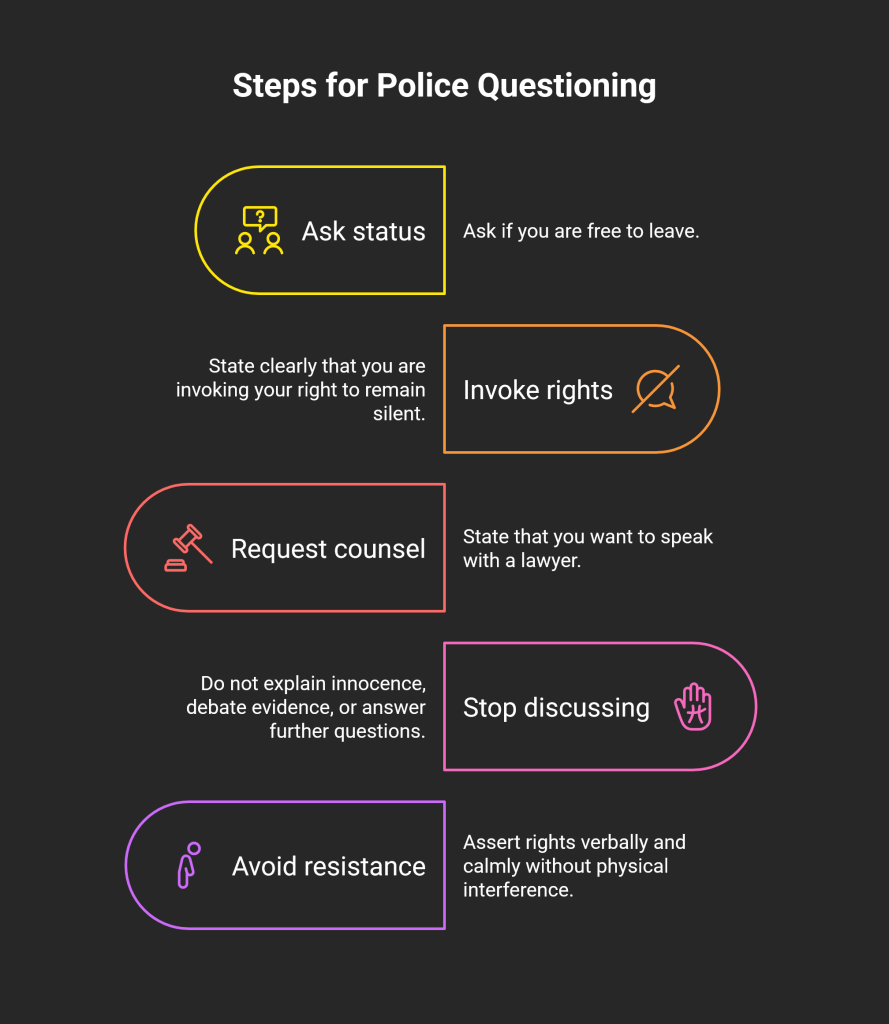
A person who wants to stop answering questions should communicate that decision clearly.
In Berghuis v. Thompkins, the U.S. Supreme Court held that a suspect’s prolonged silence did not unambiguously invoke the right to remain silent. After receiving and understanding Miranda warnings, the suspect eventually answered a question, and the answer was admitted as evidence.
Similarly, in Salinas v. Texas, prosecutors were permitted to comment on a person’s silence during a voluntary, noncustodial interview where the Fifth Amendment privilege had not been expressly invoked. The decision was divided, and its precise legal reasoning is complex, but it illustrates the danger of assuming that silence automatically carries full constitutional protection.
A clear statement is more effective than simply becoming quiet:
“I am invoking my right to remain silent. I want to speak with a lawyer. I will not answer questions.”
After invoking those rights, continuing to explain, argue, or make small talk can create new statements and complicate the legal analysis.
Asking for a Lawyer Is Not an Admission of Guilt
Innocent people sometimes fear that requesting counsel will make them appear guilty.
A lawyer’s role is not limited to defending guilty people.
Counsel can:
- Clarify whether the interview is voluntary.
- Determine whether the person is a witness or suspect.
- Learn what investigators want to discuss.
- Prevent ambiguous or speculative answers.
- Preserve constitutional objections.
- Provide relevant records in an organized manner.
- Arrange a controlled interview when speaking is strategically appropriate.
- Help correct genuinely important misunderstandings.
There are circumstances in which a lawyer may recommend providing information to investigators. The critical difference is that the decision occurs after counsel understands the facts, risks, evidence, and client’s legal position.
Declining an immediate, unprepared interview is not the same as refusing to cooperate forever.
Particularly Vulnerable Suspects
Although anyone can make damaging statements, certain people face elevated risks during interrogation:
- Children and adolescents.
- People with intellectual or developmental disabilities.
- Individuals experiencing a mental-health crisis.
- People with limited English proficiency.
- People who are intoxicated or withdrawing.
- Sleep-deprived or medically impaired individuals.
- People highly suggestible or eager to please authority.
- Individuals unfamiliar with the U.S. legal system.
Young people may focus on ending an uncomfortable interrogation rather than the long-term consequences of a statement. A person with a cognitive disability may agree with leading questions without understanding the implications. Someone with limited English proficiency may misunderstand a warning while appearing conversationally fluent.
The Innocence Project recommends safeguards including complete recording of interrogations, access to counsel, special protections for vulnerable people, restrictions on deceptive tactics, and independent corroboration of confession details.
What Innocent People Should Avoid
A person approached by police should avoid:
- Guessing about times, distances, or events.
- Offering theories about evidence they have not reviewed.
- Lying to “simplify” an uncomfortable fact.
- Deleting messages, posts, photographs, or location data.
- Contacting witnesses to coordinate accounts.
- Asking another person to provide an alibi.
- Posting about the investigation online.
- Assuming an “off-the-record” police conversation is protected.
- Believing that a friendly tone makes the interview harmless.
- Signing a statement without carefully reviewing it.
- Physically resisting an officer.
Lying to investigators can create additional legal exposure in some circumstances. Destroying or altering evidence may also lead to obstruction allegations. The safer course is generally to stop discussing the facts and obtain legal advice—not to invent a more favorable account.
“If you’re innocent, you can just explain it” is a trap.
One of the most dangerous beliefs is that truth will automatically win.
Truth is not enough. Not in investigations. Not in court. Outcomes depend on evidence, timing, interpretation, and narrative. Your story might be true, but if the system can’t verify it quickly, or if it conflicts with a witness who seems confident, you become the easiest solution.
Police departments get pressure to close cases. Detectives get caseload overload. Prosecutors want convictions. The public wants answers. The media wants a storyline.
And you, the random innocent person who happened to be nearby, are not protected by your innocence. You are protected by your rights and by your lawyer.
That’s it.
Interrogation tactics are designed to get statements, not clarity.
A lot of people still imagine interrogations like movies. Shouting, bright lights, “Where were you on the night…”
Modern tactics can be softer and more psychologically clever. Some of them rely on rapport. Some rely on minimization. Some rely on suggesting inevitability.
Things like:
- “Help me understand what happened.”
- “We already know the truth, now we just need your side.”
- “This is your chance to clear it up.”
- “If it was an accident, say it was an accident.”
- “Honesty goes a long way.”
Sometimes they will imply that asking for a lawyer makes you look guilty. Or they’ll act disappointed. Or they’ll say “we’re just talking.” Like it’s casual.
But your words are evidence. Even if the tone is friendly. Even if you’re not under arrest. Even if they say you’re free to go.
And people get confused about that last part. If you’re “free to go,” why does it feel like you can’t leave? Because social pressure is real, and officers control the environment. Many people stay and talk because leaving feels like admitting guilt.
It’s brutal. And it catches innocent people constantly.
You don’t know what they know, and that’s the point.
When you talk to police, you are playing a game with hidden rules.
They might have witness statements you haven’t heard. They might have partial forensics. They might have the wrong suspect theory. They might think the timeline is something else entirely.
You don’t know.
So you walk in trying to be helpful, but you’re answering questions shaped by a theory you can’t see. You might accidentally fit yourself into their narrative, just by trying to answer quickly.
Example.
They think the incident happened at 10:30. You know you were there at 10:45. But they keep asking questions around 10:30. So you start doubting. Maybe it was earlier? Maybe you misread the clock? You start adjusting your answer to match their confidence.
Congratulations. You just helped them build a case against you.
Not because you’re weak. Because humans calibrate to authority under uncertainty. That’s normal.
“Consent” searches turn conversations into fishing trips
Talking often leads to asking.
“Mind if we take a look at your phone?” “Mind if we search your car?” “Mind if we check inside?”
If you say yes, you’ve opened a door that is very hard to close. In 2026, phones are basically diaries with GPS. Photos. Messages. Health data. Banking. Your entire life.
And officers do not need to find “the crime” to hurt you. They can find something unrelated. They can misinterpret a message. They can pull in third parties. They can start building a different case. Or simply hand it to someone else.
Even if nothing comes from it, you’ve just created new risk for yourself, your friends, your job.
Also, “I have nothing to hide” is not a legal strategy. Privacy is not evidence of guilt. It’s a boundary. Innocent people deserve boundaries too.
Innocent people confess. Yes, really.
This is the part people hate hearing.
False confessions are a thing. They happen for reasons that make sense psychologically, even if they sound insane from the outside. Exhaustion. Fear. Confusion. Belief that cooperation will end the nightmare. Belief that evidence will clear them later. Youth. Disability. Mental health issues. Language barriers.
Sometimes people confess to something they didn’t do just to go home. Or because they think they’re agreeing to a lesser narrative like “maybe I bumped him” and it gets reframed into “I assaulted him.”
Even without a full confession, people make damaging admissions.
“I was mad.” “I yelled.” “I pushed him away.” “I did have a drink.”
Those statements can be enough to justify charges, or at least enough to justify an arrest and a messy legal process.
And the process is the punishment for many people. Legal fees. Job loss. Stress. Reputation damage. Even if you eventually win.
The legal system rewards silence more than “being nice.”
Here’s what nobody teaches in school.
The Fifth Amendment exists because talking can destroy you even when you’re innocent. The right to remain silent is not a trick. It’s not a loophole. It’s not disrespect. It is a shield.
Same with asking for a lawyer.
Lawyering up is not a confession. It is the adult way to interact with a system that has power over you.
Police can legally lie to you in many places and situations. Your lawyer cannot lie to you like that. Police can misremember, miswrite, or reinterpret what you said. Your lawyer’s job is to prevent you from stepping on a landmine you didn’t even know was in the room.
And yeah, it feels uncomfortable. It can feel rude.
But the stakes are not social. The stakes are criminal.
“But I’m just a witness” is not as safe as it sounds.
Even as a witness, talking can create problems.
Maybe you saw something near a bar fight. You tell police what you think happened. Later the video shows something different. Now you’re “lying” or “obstructing.” Or at minimum, you get pulled deeper into the case as the person whose statement doesn’t match.
Or you mention something that implicates someone you know. Now you have social fallout. Or retaliation risk. Or you get subpoenaed. Or you become part of a chain of evidence you never wanted.
Sometimes the smartest move as a witness is to give basic identifying info and then ask to speak through counsel if it’s going to become a formal statement. That sounds dramatic, but in high-stakes incidents, it’s not crazy.
But won’t staying silent make you look guilty?
Maybe to some people in the moment.
But your goal is not to look innocent. Your goal is to not get charged, not get trapped, not get misquoted, not get railroaded into a narrative you can’t escape.
Also, cops are used to people asking for lawyers. Seriously. It’s not some rare event. The awkwardness is mostly in your head because you’ve been trained your whole life to be “cooperative” with authority.
You can be cooperative without being self destructive.
Give your name if required by your local law. Provide basic ID if legally required. Don’t resist. Don’t argue on the street.
Just don’t try to talk your way out of risk.
What to Do If You Already Spoke to Police
Speaking to police does not necessarily mean the case is lost. A person who has already given a statement should:
- Stop making additional statements about the investigation.
- Write down what happened while the memory is fresh, including who was present, what was asked, what was said, and whether the conversation was recorded.
- Preserve messages, documents, photographs, call logs, location information, and other potential evidence.
- Do not contact witnesses to correct or align accounts.
- Do not post an explanation on social media.
- Tell a criminal defense lawyer the complete truth about the interview, including any inaccurate, incomplete, or embarrassing answers.
A lawyer may be able to determine whether the statement was voluntary, whether Miranda applied, whether questioning continued after an invocation, whether the report is accurate, and whether all or part of the statement can be challenged.
An uncomfortable closing thought.
A lot of innocent people talk because they believe the system will recognize innocence.
Sometimes it does.
But sometimes, the system recognizes convenience.
And words are convenient. Words are flexible. Words can be cut up, reframed, summarized, misunderstood. And once they are on paper, or on video, you can’t pull them back into your mouth.
So if you take one thing from this.
Being innocent is not a substitute for being careful.
In 2026, with investigations moving fast and data everywhere, the safest thing an innocent person can do is understand this basic rule: police questions are not a casual conversation. They are evidence gathering.
And evidence gathering is not designed for your comfort. It’s designed for a case.
 Frequently Asked Questions
If I am innocent, shouldn’t I explain what happened?
Not without first understanding the risks. An explanation may be appropriate later, but it should be considered with counsel after the evidence and circumstances are evaluated.
Do police have to tell me whether I am a suspect?
Not necessarily. Investigators may use neutral language or request a voluntary interview without fully explaining how they view the person.
Can police lie during an interrogation?
Police deception is permitted in various circumstances under U.S. law, although the rules and restrictions differ by jurisdiction. Some states have adopted additional protections, particularly for juveniles. Any claim about evidence should be evaluated through counsel rather than answered with speculation.
Does asking for a lawyer make me look guilty?
Requesting legal advice is an exercise of a constitutional right, not an admission. Innocent people can face serious consequences from misunderstood or incomplete statements.
Can police keep questioning me if I remain silent?
Silence alone may not clearly invoke the right. A person should state unambiguously that they are invoking the right to remain silent and want a lawyer.
What if police say this is my only chance to explain?
Do not assume that an immediate interview is the only opportunity to provide information. A lawyer may be able to communicate with investigators or arrange a more controlled exchange later.
Should I lie if the truth sounds suspicious?
No. Lying can damage credibility and may create separate legal problems. The safer response is to decline to discuss the facts until counsel is present.
The Bottom Line
Innocent people sometimes hurt their cases by talking to police because they misunderstand the purpose and risks of an investigative interview.
They expect innocence to protect them. They try to be helpful, fill gaps in memory, explain supposed evidence, or provide precise answers where certainty is impossible. Investigators may interpret ordinary mistakes as deception, omissions as concealment, and speculation as a changing story.
In some cases, intense or prolonged questioning can contribute to a false confession—especially when the person is young, cognitively vulnerable, exhausted, frightened, or misled about the evidence.
The right to remain silent is not reserved for guilty people. It exists because the pressures and evidentiary risks of police questioning can affect anyone.
A calm, clear response is usually safer than an improvised explanation:
“I am invoking my right to remain silent. I want to speak with a lawyer. I will not answer questions.”
Then stop discussing the facts and seek advice from a qualified criminal defense attorney.
Colorado Criminal Law – I have nothing to hide – Part 2 of 2 – Why You DO NOT Want To Talk To The Police
The reader is alerted that Colorado criminal law, like criminal law in every state and at the Federal level, changes constantly. The article above was accurate when it was drafted, but it cannot account for changes that occurred after it was uploaded.
 ABOUT THE AUTHOR: H. Michael Steinberg – Email the Author at: hmsteinberg@hotmail.com
A Denver, Colorado Criminal Defense Lawyer – call his office at 303-627-7777 during business hours, or call his cell at 720-220-2277 if you cannot wait and need his immediate assistance.
“A good criminal defense lawyer is someone who devotes themselves to their client’s case from beginning to end, always realizing that this case is the most important thing in that client’s life.”
Putting more than 40 years of Colorado criminal defense experience to work for you.
One should be careful when selecting a Colorado criminal defense lawyer. We encourage you to “vet” our firm. Over the last 40 years – by focusing ONLY on Colorado criminal law – H. Michael has had the time to continually update himself in nearly every area of criminal law, including procedure, trial, and courtroom practice.
H. Michael works hard to deliver the best possible results for his clients, both in and out of the courtroom. He has written extensively on Colorado criminal law and continues to do so, and he hopes this article helps you in some small way.